
Table of Contents
- What Collagen Does for Your Joints
- Types of Collagen and Which Works Best for Joint Pain
- How Long Does It Take for Collagen to Work for Joints
- Collagen Dosage for Joint Support
- Hydrolyzed Collagen Peptides and Bioavailability
- Synergistic Nutrients That Enhance Collagen's Effects
- Conclusion
Last Updated: August 26, 2026
What Collagen Does for Your Joints
Collagen is the most abundant protein in the human body, making up roughly 30% of total protein content and serving as the structural foundation for connective tissues (peer-reviewed research). For joint health specifically, collagen forms the critical matrix within cartilage that allows smooth movement and absorbs impact. When collagen degrades, whether from aging, overuse, or inflammation, joints lose elasticity, cushioning capacity, and mobility. This is where supplemental collagen for joint health becomes relevant.

The relationship between collagen and joint function operates through several interconnected mechanisms. Cartilage itself is roughly 70% water and 20% collagen by dry weight, with Type II collagen being the dominant structural form (peer-reviewed research). When you consume collagen, especially hydrolyzed collagen peptides, your digestive system breaks it into amino acids and small peptide chains that can cross the intestinal barrier. These bioavailable fragments circulate through your bloodstream and accumulate in joint tissues, where they may stimulate fibroblasts (cells responsible for synthesizing new collagen) to produce fresh cartilage matrix.
Beyond structural repair, collagen supports synovial fluid production. This lubricating fluid reduces friction between bone surfaces and provides nutrients to cartilage cells that don't have direct blood supply. Adequate collagen also influences bone turnover, the process by which old bone is replaced with new bone tissue. Athletes and individuals managing joint discomfort often report improvements in joint mobility and reduced joint tenderness after consistent collagen supplementation, though the timeline varies significantly based on dosage, type, and individual factors.
At Nirvana Wellness Store, understanding collagen's role in joint architecture helps customers make informed decisions about supplementation. The key insight is that collagen doesn't work in isolation, it requires supporting nutrients, adequate hydration, and realistic expectations about timing.
Types of Collagen and Which Works Best for Joint Pain
Your body produces at least 28 different types of collagen, but only a handful directly impact joint health. Type I collagen dominates in tendons, ligaments, and bone. Type II collagen is the primary structural protein in cartilage and is the most relevant for managing joint discomfort. Type III collagen supports skin elasticity and is often found alongside Type I in connective tissues. When evaluating collagen supplements for joints, Type II is the most targeted choice for cartilage support.
However, most commercial supplements use hydrolyzed collagen peptides derived from Type I sources (typically from bovine or marine origins). These aren't ineffective for joints, they provide glycine, proline, and hydroxyproline, amino acids that your body can use to synthesize new collagen of any type. The advantage of hydrolyzed collagen peptides is superior bioavailability. The hydrolysis process breaks collagen molecules into smaller chains (2,000-5,000 Daltons), making them absorbable through the intestinal wall, whereas unhydrolyzed collagen is too large to cross intact.
Type II collagen supplements do exist as undenatured (native) forms, where the collagen triple helix remains intact. These products contain bioactive peptides that may have immunomodulatory effects, potentially signaling your immune system to reduce inflammatory responses in joint tissue. Some individuals report faster results with undenatured Type II, though research on this distinction remains limited.
For practical purposes, hydrolyzed collagen peptides work well for joint support because the amino acid profile supports collagen synthesis regardless of source. Marine collagen peptides absorb slightly faster than bovine sources due to smaller molecular weight, but both deliver results. The real differentiator is consistency and dosage rather than type alone. Many people switching from sporadic use to daily supplementation see improvements within 4-12 weeks simply because they're now providing sustained substrate for collagen production.
How Long Does It Take for Collagen to Work for Joints
This is the question that separates realistic expectations from disappointment. Collagen doesn't work like a pain reliever, you won't feel relief within hours. Instead, it works through gradual tissue remodeling. Your body replaces cartilage matrix continuously, but the process is slow. Cartilage has minimal blood supply, so nutrient delivery depends on diffusion through synovial fluid and movement-driven fluid exchange. This means collagen accumulation in joint tissue happens gradually.
Most people report noticing changes between 4 and 12 weeks of consistent daily supplementation. Some feel improvements in joint mobility or reduced morning stiffness within 3-4 weeks. Others require 8-12 weeks before meaningful changes emerge. A small percentage notice nothing even after 12 weeks, which may reflect individual variation in absorption, existing inflammation levels, or whether collagen supplementation alone is sufficient for their particular situation.
The timeline also depends on your baseline condition. Someone with mild joint stiffness may see results faster than someone with advanced cartilage degradation. Athletes experiencing post-workout soreness often notice faster improvements than individuals with chronic joint pain. Dosage matters significantly, higher doses (10-20 grams daily) tend to show results faster than lower doses (5 grams daily), though more research on optimal dosing is needed.
A practical approach: commit to daily collagen supplementation for 8-12 weeks before evaluating effectiveness. Track specific metrics like morning stiffness duration, range of motion in affected joints, or pain levels during specific activities. This gives your body adequate time to accumulate collagen in joint tissues and allows you to measure subtle improvements you might otherwise miss.
Collagen Dosage for Joint Support
Research on optimal collagen dosage for joint health suggests a range rather than a single magic number. Studies examining joint mobility and cartilage markers have used doses ranging from 5 to 20 grams daily, with most showing measurable effects at 10 grams or higher (peer-reviewed research). The most commonly cited dosage in research examining joint-related outcomes is 10 grams daily, typically divided into smaller doses or taken once daily depending on the supplement format.
Higher doses (15-20 grams daily) may accelerate results, particularly for individuals with significant cartilage degradation or those seeking faster improvements in mobility. However, more isn't always better, your body can only absorb and use a certain amount of collagen peptides at once. Excess amino acids are metabolized for energy or converted to other compounds rather than directed toward joint tissue.
For practical supplementation, start with 10 grams daily for 8-12 weeks. If you see no improvement, consider increasing to 15 grams daily for another 8-12 weeks. If you're already seeing positive changes, maintain that dose rather than escalating. Consistency matters more than dose size, taking 10 grams daily for 12 weeks beats taking 20 grams sporadically.
Timing may also matter. Some evidence suggests taking collagen with vitamin C and alongside a meal containing fat may enhance absorption, though individual variation is significant. Hydration status influences bioavailability as well, dehydration reduces the efficiency of amino acid transport. This is why collagen supplementation works best as part of a broader joint-health approach that includes adequate water intake, movement, and supporting nutrients.
Hydrolyzed Collagen Peptides and Bioavailability
Hydrolyzed collagen peptides represent the most researched and practical form of collagen supplementation for joint health. Hydrolysis is an enzymatic process that breaks collagen's long chains into smaller peptides, typically in the 2,000-5,000 Dalton range. This molecular size matters because it determines whether your intestines can absorb the collagen intact or must break it down further into individual amino acids.
Unhydrolyzed collagen (like gelatin or bone broth) has molecules of 30,000+ Daltons, too large to cross the intestinal barrier intact. Your digestive system must break these down into amino acids before absorption, which takes longer and may result in lower bioavailability. Hydrolyzed peptides, by contrast, can be absorbed directly through your intestinal wall, entering your bloodstream within 30-60 minutes of consumption. This direct absorption pathway means more collagen-derived amino acids reach your systemic circulation rather than being metabolized by your gut bacteria.
Bioavailability also depends on your individual digestive health. People with compromised gut barrier function (leaky gut), inflammatory bowel conditions, or poor stomach acid production may absorb less efficiently. This is why some individuals see results quickly while others require higher doses or longer timeframes. Factors like age, inflammation status, and concurrent medications all influence how much collagen your body actually absorbs and utilizes.
The form of hydrolyzed collagen matters too. Collagen peptides mixed into cold beverages are easier to consume daily than bone broth or gelatin, which require heating and have limited shelf stability. Capsule forms offer convenience but deliver smaller doses per serving. Powder forms allow flexible dosing and can be mixed into various foods and beverages. For consistent daily intake, powder or capsule forms tend to work best because they fit easily into existing routines.
One practical consideration: hydrolyzed collagen peptides are flavorless and odorless, making them easy to add to coffee, smoothies, soups, or plain water without altering taste. This accessibility supports compliance, which directly impacts results. A supplement you'll actually take daily outperforms a "better" supplement you forget or find unpalatable.
Synergistic Nutrients That Enhance Collagen's Effects
Collagen doesn't work in isolation. Several micronutrients directly support collagen synthesis, absorption, and the structural integrity of joint tissue. Vitamin C is perhaps the most critical synergist, it's a required cofactor for collagen cross-linking, the chemical bonds that give collagen its strength and stability. Without adequate vitamin C, your body cannot properly stabilize new collagen molecules. This is why many quality collagen supplements include vitamin C, and why taking collagen alongside vitamin C-rich foods (citrus, berries, leafy greens) enhances its effectiveness.
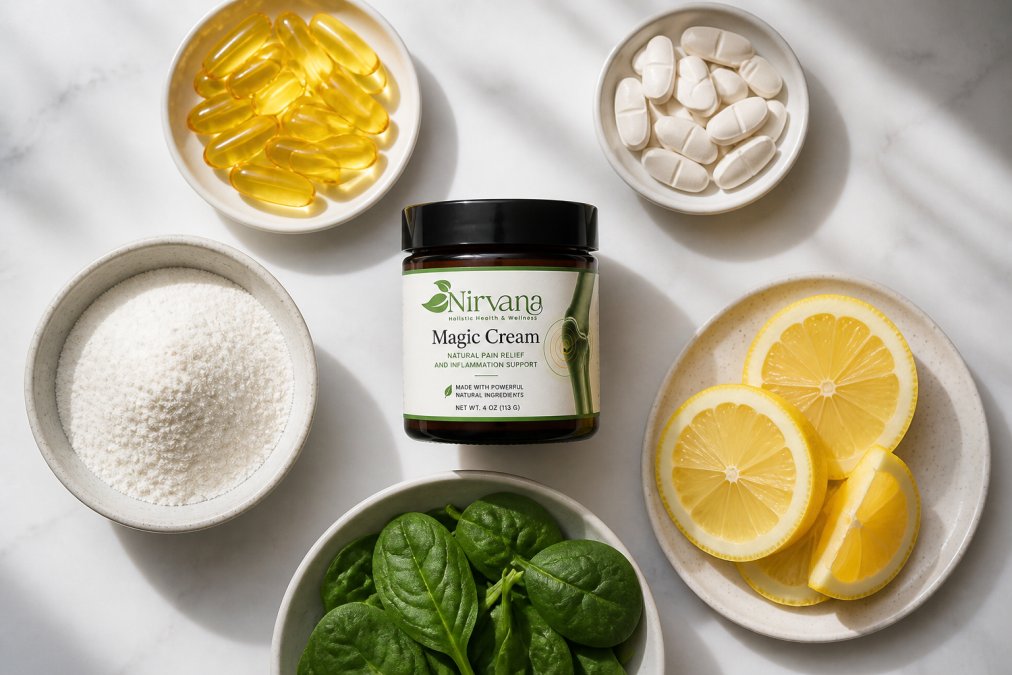
Copper and zinc are trace minerals essential for collagen cross-linking and fibroblast function. Many people are deficient in these minerals without realizing it, which can limit their body's ability to synthesize new collagen even when amino acid precursors are abundant. Copper supports lysyl oxidase, the enzyme that initiates collagen cross-linking. Zinc activates matrix metalloproteinases, enzymes that remodel collagen and maintain cartilage matrix integrity. A simple multivitamin covering these micronutrients often improves collagen supplementation outcomes.
Omega-3 fatty acids (EPA and DHA) support joint health through inflammation reduction and may enhance collagen's effectiveness. The Nirvana Omega-3 Capsules provide 1,200 mg of fish oil with 720 mg of omega-3 fatty acids per serving, delivering the EPA and DHA concentrations that research associates with joint mobility support. Omega-3s integrate into cell membranes and reduce inflammatory signaling, creating an environment where collagen can function optimally.

Glucosamine and chondroitin are often paired with collagen, though their mechanisms differ. Glucosamine provides substrate for glycosaminoglycan synthesis (molecules that hold water in cartilage), while chondroitin inhibits cartilage-degrading enzymes. Together with collagen, they address cartilage from multiple angles, collagen provides structure, glucosamine supports water retention, and chondroitin slows degradation. This combination approach often produces faster or more noticeable results than collagen alone.
Hydration deserves mention as a foundational synergist. Cartilage is 70% water. Dehydration reduces synovial fluid production and impairs nutrient diffusion into cartilage. Drinking adequate water (at least 8-10 glasses daily for most adults) supports collagen absorption and joint lubrication far more effectively than any supplement can compensate for. Movement is another critical synergist, exercise drives synovial fluid circulation, which delivers collagen and other nutrients to cartilage. Sedentary individuals often see slower results from collagen supplementation than those who maintain regular movement.
The Nirvana Magic Cream can complement oral collagen supplementation by providing topical support for joint discomfort. While topical products cannot deliver collagen through the skin barrier, the natural pain relief formula may reduce inflammation in affected joints, creating a more favorable environment for oral collagen to work. Using both approaches simultaneously, oral collagen for internal cartilage rebuilding and topical relief for immediate comfort, often produces better outcomes than either alone.

Collagen for joint health works, but it works through tissue remodeling rather than immediate symptom relief. Success requires consistency (daily supplementation), realistic timelines (8-12 weeks minimum), adequate supporting nutrients (vitamin C, omega-3s, minerals), and lifestyle factors (movement, hydration). If you're managing joint discomfort and looking for a natural, research-supported approach, collagen supplementation paired with the right supporting nutrients and products, like those curated at Nirvana Wellness Store, provides a practical pathway to improved joint mobility and reduced joint tenderness over time.
Frequently Asked Questions
Q: How long does it take for collagen to work for joints?
A: Most people notice improvements in joint mobility and stiffness within 4 to 12 weeks of consistent collagen supplementation. Clinical studies using hydrolyzed collagen peptides show that therapeutic dosages (10 grams daily) produce measurable changes in joint functionality and cartilage support over 8-12 weeks. Results vary based on dosage, collagen type, bioavailability, and individual factors like age and activity level. Patience and consistency matter, short-term expectations often lead to disappointment.
Q: What is the best type of collagen for joint pain?
A: Type II collagen is the primary structural component of cartilage and is most directly relevant to joint health. Type I collagen supports tendons and ligaments. Many formulas combine Type I and Type II for comprehensive joint, tendon, and ligament support. Hydrolyzed collagen peptides offer superior bioavailability compared to whole collagen, meaning your body absorbs and utilizes them more efficiently. When selecting a supplement, prioritize hydrolyzed forms and look for clinical evidence supporting the specific product.
Q: Does collagen actually work for joints?
A: Clinical evidence supports collagen's role in joint health. Placebo-controlled trials demonstrate that hydrolyzed collagen peptides reduce joint tenderness, improve range of motion, and support cartilage matrix integrity. Collagen provides glycine, proline, and hydroxyproline, amino acids essential for connective tissue repair and collagen synthesis. Results are most pronounced in people with existing joint discomfort or those engaging in regular physical activity. Collagen works best as part of a comprehensive approach that includes movement, proper nutrition, and other joint-supporting nutrients.
Q: What dosage of collagen should I take for joint support?
A: Clinical studies show therapeutic benefits at 10 grams (10,000 mg) of hydrolyzed collagen peptides daily, divided into one or two doses. Some research supports dosages between 8 and 15 grams daily depending on body weight and joint condition severity. Consistency matters more than exceeding recommended amounts, daily supplementation over weeks produces better results than sporadic high doses. Start at 10 grams daily and maintain for at least 8-12 weeks to assess effectiveness. Always follow product-specific dosage instructions and consult a healthcare provider if you have underlying health conditions.
This article was written using GrandRanker