


Table of Contents
- Why Women Look for Natural Alternatives to Minoxidil
- Causes of Female Hair Thinning: Hormonal vs. Non-Hormonal
- Rosemary Oil for Hair Growth: What the Research Shows
- Other Botanical Extracts and Essential Oils for Scalp Health
- How to Use Scalp Massage for Hair Growth
- Microneedling, Low-Level Laser Therapy, and Nutritional Support
- Choosing Natural Hair Growth Products: What to Look For
- Frequently Asked Questions
Last Updated: September 19, 2026
Why Women Look for Natural Alternatives to Minoxidil
Women searching for natural alternatives to minoxidil often do so after side effects they were never warned about. This guide examines what the evidence supports and how to build a routine that works.
Side Effects and Drawbacks of Minoxidil
The most common complaint is scalp irritation: itching, flaking, and redness at the application site. Some women develop contact dermatitis; others report unwanted facial hair from solution migrating during sleep.
Causes of Female Hair Thinning: Hormonal vs. Non-Hormonal
Female hair thinning falls into two categories, hormonal and non-hormonal, and the distinction determines which natural alternatives to minoxidil for women are worth trying.
Rosemary Oil for Hair Growth: What the Research Shows
Rosemary oil for hair growth has the strongest evidence base of any botanical in this category, likely via improved scalp microcirculation and possible DHT inhibition at the follicle.
Other Botanical Extracts and Essential Oils for Scalp Health
Beyond rosemary, several botanicals have earned attention for scalp health and hair density support, but the evidence varies widely, some have human trial data, some only mechanistic plausibility, some are marketing with a Latin name. Here is an honest tiering, plus the dilution and integration details most guides skip.
Tier 1: Botanicals With Human Data
Pumpkin seed extract is the most promising non-hormonal DHT modulator in the botanical category. It appears to interfere with the conversion of testosterone into dihydrotestosterone (DHT), the same pathway that drives androgenetic alopecia. In one commonly cited randomized trial, oral pumpkin seed oil was associated with increased hair count over 24 weeks in men with androgenetic alopecia (pubmed.ncbi.nlm.nih.gov). That is a male-population study, so extrapolate carefully, but the mechanism is relevant for women with hormonal thinning.
Tier 2: Botanicals With Mechanistic Support
Peppermint oil creates a cooling sensation that increases blood flow to the scalp surface. In animal models it has outperformed minoxidil on some growth measures, but human data is thin. Treat it as a supporting player, not a primary active.
Tier 3: Popular but Overhyped
Biotin oil, onion juice, garlic paste, and castor oil for "growth" are common in DIY routines. Castor oil is a fine occlusive carrier but does not regrow hair. Onion and garlic have small, methodologically flawed studies and a real risk of contact dermatitis. Skip them if your scalp is reactive.
Carrier Oil Dilution Ratios: The Safety Layer
Essential oils for scalp health must be diluted. Undiluted application causes chemical burns and scalp inflammation, the opposite of what you want when supporting hair regrowth.
Carrier oils differ in weight and behavior:
- Jojoba, lightest, closest to sebum, best for daily use and oily scalps.
- Argan, mid-weight, absorbs quickly, good for fine hair.
- Castor, heaviest and most occlusive; use as a small fraction of a blend, not the whole base, or it will leave residue and clog follicles.
- Fractionated coconut, stable, odorless, and thin; a good neutral base if you dislike the scent of jojoba.
Integration: How to Stack Without Irritating Your Scalp
A workable weekly structure:
- 2-3 nights per week: leave-on carrier oil blend with rosemary and pumpkin seed, massaged in for 2-5 minutes.
- 1 night per week (if using): microneedling on clean scalp, followed by plain carrier oil only.
- Remaining nights: nothing, or a light jojoba application. Scalp skin needs recovery nights.
- Daily: oral supplement and protein intake.
For women who want the topical layer handled in one pre-diluted product rather than mixing their own, Nirvana Hair Growth Oil is a lightweight botanical blend for daily or weekly use. It helps moisturize hair follicles and scalp, supports natural hair care routines for textured and curly hair, and works for thinning hair, dry scalp, postpartum hair recovery, and edges and crown support.
How to Use Scalp Massage for Hair Growth
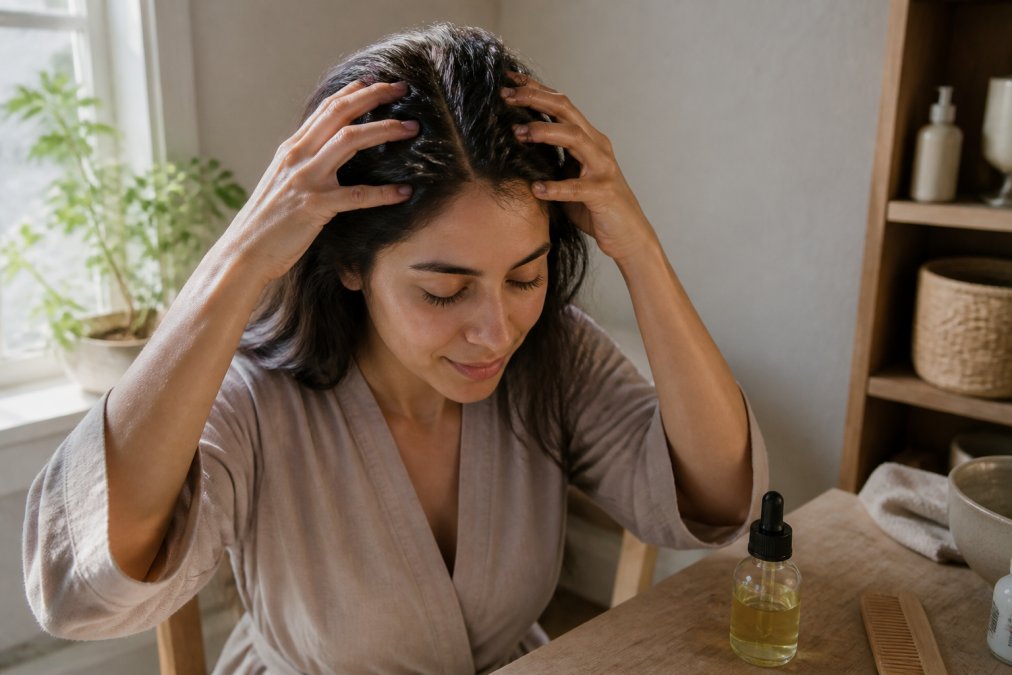
Scalp massage for hair growth increases scalp microcirculation and reduces tension in the muscles around the follicles. It costs nothing, takes five minutes, and pairs with any topical treatment you already use.
Nirvana Hair Growth Oil - 4 Oz →
Microneedling, Low-Level Laser Therapy, and Nutritional Support
Microneedling, low-level laser therapy (LLLT), and nutritional support are the three "force multipliers" in a natural hair routine. None regrow hair alone; each makes the other interventions work better, which is why competitors list them but rarely explain how to run them without hurting your scalp.
Microneedling: Depth, Frequency, and What Not to Do
Microneedling uses a roller or stamp with fine needles to create controlled micro-channels in the scalp. The two proposed benefits are mechanical: a wound-healing response that may nudge resting follicles into anagen, and temporarily increased transdermal absorption of whatever you apply afterward.
A few practical rules:
- Sanitize before and after. Soak the roller in 70% isopropyl alcohol for at least 5 minutes, then let it air-dry. Replace rollers every 8 to 10 uses; dull needles tear rather than puncture.
- Do not microneedle over an active breakout, psoriasis plaque, or open wound. You will drive bacteria in, not product.
- Apply your topical after, not before. Rolling over oil first just pushes oil into the channels unevenly. Roll on clean, dry scalp, then apply your leave-on oil.
- Skip actives on microneedling nights. Essential oils at full dilution on freshly punctured skin sting and inflame. Use a plain carrier oil or a pre-diluted blend.
Low-Level Laser Therapy: What the Devices Actually Do
LLLT devices, caps, bands, and combs, emit red or near-infrared light (typically 630-670 nm) absorbed by mitochondria in the hair follicle, supporting cellular energy production. The FDA has cleared several LLLT devices for androgenetic alopecia, giving the category regulatory footing most botanicals lack.
Nutritional Support: The Nutrients That Actually Move the Needle
Hair is a non-essential tissue from your body's perspective, so nutritional deficiencies show up there before almost anywhere else. The nutrients with the clearest link to hair shaft thickness and the growth cycle are:
- Iron (with ferritin checked). Low ferritin, even without anemia, is one of the most common reversible causes of diffuse shedding in women. Ask your practitioner to check ferritin, not just hemoglobin.
- Vitamin D. Deficiency is widespread and associated with telogen effluvium. Typical maintenance dosing is 1,000-2,000 IU daily, but dose to your blood level, not to a label.
- Zinc. Supports follicle growth and repair. Long-term high-dose zinc depletes copper, so stay within a multivitamin range unless a practitioner directs otherwise.
- B vitamins, especially biotin and B12. Biotin only helps if you are deficient; megadoses do not accelerate growth in well-nourished women and can interfere with lab tests.
- Protein. Hair is largely keratin. Chronic under-eating or low protein intake shows up as shedding within 2 to 3 months.
Stack these three in order of friction: nutrition first (lowest effort, highest baseline impact), LLLT second (no irritation risk), microneedling last (highest skill requirement). Add one at a time so you can tell what is working, and so you do not irritate your scalp into a setback.
Choosing Natural Hair Growth Products: What to Look For
The natural hair care market is crowded with products that list impressive botanicals at concentrations too low to matter. Here is how to separate real formulas from marketing.
| What to Check | Red Flag | What Good Looks Like |
|---|---|---|
| Ingredient position | Active botanicals listed last | Key oils in the first half of the list |
| Carrier base | Alcohol as the first ingredient | Jojoba, argan, or castor as the base |
| Dilution | Undiluted essential oils | Pre-diluted, scalp-safe concentration |
| Format | Rinse-off shampoo only | Leave-on oil or serum |
| Claims | "Regrows hair in 7 days" | Honest language about supporting scalp health |
Frequently Asked Questions
What is the most effective natural alternative to minoxidil?
Rosemary oil has the strongest research backing among natural alternatives. A randomized trial found rosemary oil improved hair count after six months, with results comparable to 2% minoxidil. Pumpkin seed extract and peppermint oil also show promise for androgenetic alopecia. Most natural options work best as part of a consistent routine that includes scalp massage, proper nutrition, and gentle hair care. Results typically take three to six months, so patience matters.
Can rosemary oil really replace minoxidil for hair growth?
For mild to moderate hair thinning, rosemary oil for hair growth shows comparable results to 2% minoxidil in some studies. However, it works differently, supporting scalp microcirculation and reducing inflammation rather than directly extending the anagen phase. If you have significant follicular miniaturization or advanced androgenetic alopecia, rosemary oil alone may not be enough. Many women use it alongside other natural approaches like scalp massage and DHT-blocking botanical extracts.
How long does it take to see results with natural hair growth remedies?
Natural remedies typically require three to six months of consistent use before visible changes appear. The hair growth cycle moves slowly, and the anagen phase must complete before you see new growth. Rosemary oil studies showed results at six months. Scalp massage and nutritional support may improve hair density sooner, but expect at least 12 weeks before judging whether a natural alternative to minoxidil is working for you.
Is it safe to switch from minoxidil to natural hair treatments?
Switching is generally safe, but stopping minoxidil often triggers shedding within two to three months as hair returns to its previous growth pattern. If you want to transition, start your natural routine before tapering off minoxidil so your scalp stays stimulated. Talk to a dermatologist about your specific causes of female hair thinning, especially if you have hormonal conditions like PCOS. Natural alternatives work best as a gradual transition, not an abrupt swap.
What ingredients should I look for in natural hair growth serums?
Look for rosemary oil, pumpkin seed extract, peppermint oil, and carrier oils like jojoba or argan that help with transdermal absorption. Products with botanical extracts that support scalp microcirculation and reduce scalp inflammation tend to work best. Avoid formulas with high essential oil concentration undiluted, as they can irritate the scalp. A lightweight oil you can apply three to four times weekly without buildup is ideal for consistent use.