
Table of Contents
- What Is Joint Mobility and Why It Matters
- Joint Mobility Exercises for Beginners
- Building a Daily Mobility Routine for Stiffness
- Best Supplements for Joint Health
- Nutrition and Lifestyle Support for Joint Lubrication
- Progressive Overload: Advancing Your Mobility Work
- Common Mistakes to Avoid When Improving Mobility
- Conclusion
- Frequently Asked Questions
Last Updated: September 2, 2026
What Is Joint Mobility and Why It Matters
Joint mobility is your body's ability to move your joints through their full range of motion with control and stability. It's different from flexibility, which is simply how far a muscle can stretch, because mobility combines flexibility, stability, and neuromuscular control all at once. When your joints move freely, your daily activities feel easier, from reaching for items on high shelves to bending down to pick something up.
Many people assume stiff joints are just a normal part of aging. That's not entirely accurate. Joint stiffness often develops from inactivity, poor posture, or repetitive movement patterns that leave certain joints underused. The good news is that improving joint mobility at home is entirely achievable with consistent, targeted work.
Your joints depend on synovial fluid, a lubricating substance inside your joint capsule, to function smoothly (peer-reviewed research). Movement stimulates the production and distribution of this fluid, which reduces friction and supports cartilage health. Without regular movement through full ranges of motion, your joints become stiff, your connective tissue tightens, and pain often follows. This is why sedentary periods, even just a few hours at a desk, can leave you feeling locked up.
At Nirvana Wellness Store, we offer products designed to support individuals managing chronic joint discomfort. An effective approach often combines regular mobility work with targeted nutrition and lifestyle adjustments. When you improve joint mobility systematically, you're not just moving better, you're supporting the underlying structures that keep your joints healthy long-term.

Joint Mobility Exercises for Beginners
Starting with foundational movements prepares your body for more advanced work. These beginner exercises focus on low-impact movement that gently takes your joints through their natural range of motion. Perform each exercise slowly and deliberately, speed isn't the goal here. Control and awareness are.
Shoulder Rolls and Arm Circles
Your shoulders are among the most mobile joints in your body, but they're also frequently neglected. Shoulder rolls and arm circles restore full shoulder mobility and improve posture, which is crucial since poor shoulder positioning often causes neck and upper back tension.
How to perform shoulder rolls:
- Stand with feet shoulder-width apart and arms at your sides
- Slowly lift your shoulders up toward your ears
- Roll them backward in a smooth, circular motion
- Complete 8-10 backward rolls, then reverse direction for 8-10 forward rolls
- Move slowly enough that you can feel each part of the motion
How to perform arm circles:
- Stand with feet shoulder-width apart and extend both arms out to the sides at shoulder height
- Make small circles forward for 10-15 repetitions
- Gradually increase the circle size over several repetitions
- Reverse direction and repeat
- Perform 2-3 sets total
These movements activate your shoulder joint capsule and surrounding muscles without strain. Many people find that adding shoulder rolls to their morning routine immediately reduces neck tension.
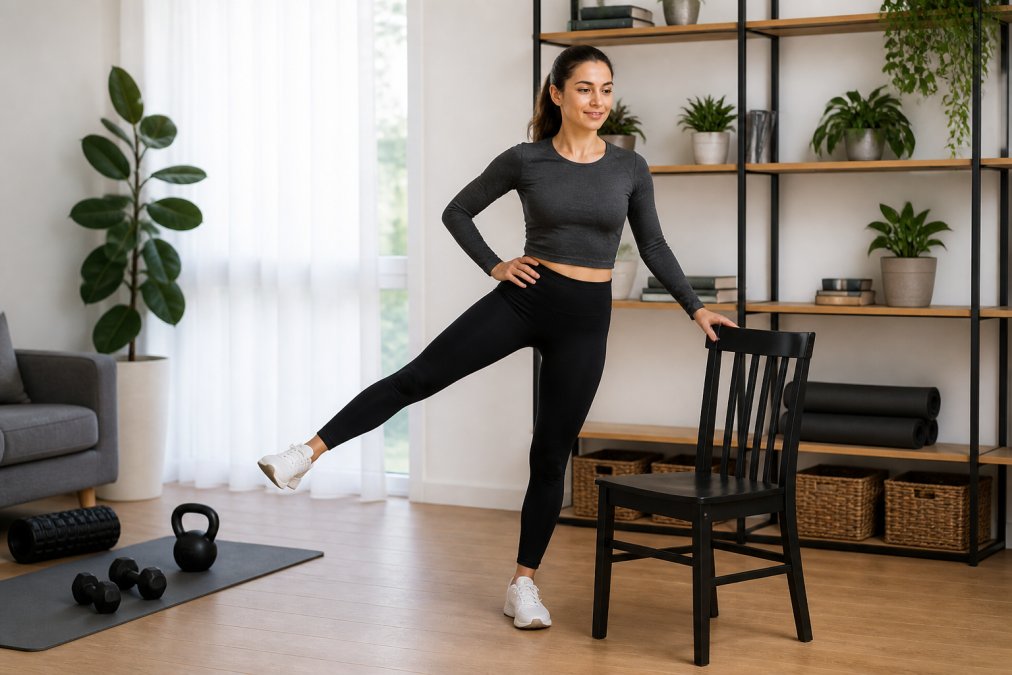
Hip Circles and Leg Swings
Your hips carry most of your body weight and drive movement in walking, climbing stairs, and bending. Hip mobility directly affects your lower back, knees, and ankles. Stiff hips force compensation patterns throughout your lower body, which often leads to pain elsewhere.
How to perform hip circles:
- Stand on one leg, placing your hand on a wall or chair for balance
- Lift your other knee to hip height
- Move your knee in slow, controlled circles, forward, out to the side, back, and in
- Complete 8-10 circles in each direction
- Switch legs and repeat
How to perform leg swings:
- Stand facing a wall with hands on the wall at shoulder height
- Swing one leg forward and backward in a controlled motion
- Allow the leg to swing naturally without forcing it
- Perform 10-12 swings, then switch legs
- Repeat for 2 sets per leg
Leg swings activate your hip joint through dynamic movement, which is different from static stretching. This dynamic approach helps your nervous system understand how to control your hip through its full range of motion.
Neck Rotations and Spine Twists
Your neck and spine contain numerous small joints that easily become restricted from desk work, phone use, and forward-leaning postures. Gentle rotations and twists restore mobility without forcing movement.
How to perform neck rotations:
- Sit upright with shoulders relaxed
- Slowly turn your head to look over your right shoulder
- Hold for 2-3 seconds, then return to center
- Repeat on the left side
- Perform 8-10 rotations per side, moving slowly
How to perform spine twists:
- Sit upright with feet flat on the floor
- Cross your right arm across your chest and gently pull your left knee toward your right shoulder
- Allow your spine to rotate naturally, don't force the twist
- Hold for 15-20 seconds
- Switch sides and repeat
- Perform 2-3 sets per side
Neck and spine mobility directly affects posture and reduces tension headaches. Many people notice improved posture within days of consistent neck rotation work.
Building a Daily Mobility Routine for Stiffness
A structured daily routine creates consistency, which is what actually drives improvement. Rather than sporadic stretching sessions, a dedicated mobility routine trains your nervous system to maintain and expand your range of motion.
Morning Warm-Up Sequence
Your joints are stiffest first thing in the morning because you've been stationary for 8+ hours. A morning warm-up sequence activates your joints, increases blood flow, and prepares your body for the day ahead.
5-minute morning mobility sequence:
- Perform 10 shoulder rolls backward and forward (1 minute)
- Do 10 hip circles per leg (2 minutes)
- Complete 8-10 neck rotations per side (1 minute)
- Perform 5 spine twists per side, holding 15 seconds each (1 minute)
This sequence takes minimal time but activates all major joints. Consistency matters more than duration, a 5-minute routine performed daily beats a 30-minute session done once a week.
Many people find that morning mobility work reduces stiffness throughout the day and improves their ability to move with control. The key is performing this routine before you sit down for extended periods, which means ideally right after waking up.
Active Recovery Between Workouts
If you exercise regularly, active recovery days are where mobility work becomes especially valuable. Active recovery involves low-intensity movement that promotes blood flow without creating additional fatigue.
On active recovery days, focus on:
- Controlled articular rotations of major joints (shoulders, hips, ankles)
- Gentle dynamic stretching through full ranges of motion
- Slow, deliberate movement with emphasis on proprioception, your body's awareness of where it is in space
- 15-20 minutes of total movement
Active recovery accelerates muscle soreness reduction and prevents the joint stiffness that often follows intense training. Athletes who incorporate regular mobility work report better performance and fewer injuries.
Best Supplements for Joint Health
While movement is the foundation of joint health, targeted supplementation supports the underlying structures that make mobility possible. Your joints require specific nutrients to maintain cartilage, reduce inflammation, and keep synovial fluid healthy.
Omega-3 fatty acids support joint lubrication and help manage inflammation. Nirvana Omega-3 Capsules deliver 1,200 mg of fish oil per softgel with 720 mg of omega-3 fatty acids, including 432 mg EPA and 288 mg DHA. These essential fatty acids support joint function and overall musculoskeletal health. Many people find that consistent omega-3 supplementation reduces joint stiffness over 4-6 weeks of daily use.

Vitamin D3 and K2 work together to support bone density, calcium metabolism, and joint stability. Nirvana Vitamin K2 + D3 combines these nutrients in a single supplement designed to support healthy bones and proper calcium use. Adequate vitamin D3 levels are essential for joint function, and deficiency can contribute to joint pain and stiffness.
Topical support complements internal supplementation. Nirvana Magic Cream provides fast-acting natural pain relief and is formulated to help soothe discomfort while supporting mobility. Many customers apply it to joints before their mobility routine to enhance comfort during movement.
The combination of movement, supplementation, and topical support creates a comprehensive approach to joint health. Supplements work best when paired with consistent mobility training, neither alone is sufficient for lasting improvement.
Nutrition and Lifestyle Support for Joint Lubrication
Your joints require specific nutrients to produce and maintain healthy synovial fluid. Nutrition directly affects connective tissue quality, inflammation levels, and your body's ability to repair joint structures.
Hydration is foundational. Synovial fluid is largely water, and dehydration reduces its production and effectiveness. Aim for consistent water intake throughout the day, a common target is half your body weight in ounces daily (the CDC). This simple adjustment often reduces joint stiffness noticeably within days.
Collagen-supporting nutrients help maintain cartilage and connective tissue integrity. Vitamin C, copper, and amino acids (especially glycine and proline) are essential for collagen synthesis. Bone broth, citrus fruits, and properly prepared protein sources provide these nutrients.
Reduce inflammatory foods when possible. While individual responses vary, many people find that reducing refined carbohydrates and processed seed oils decreases joint inflammation. This doesn't require elimination, simply reducing frequency often helps.
Sleep quality directly affects joint recovery. During sleep, your body repairs connective tissue and produces growth hormone, which supports tissue healing. Poor sleep accelerates joint stiffness and pain. Prioritizing 7-9 hours nightly is one of the most underrated joint health strategies.
Stress management matters. Chronic stress increases inflammation systemically, which affects joints. Regular movement, meditation, or other stress-reduction practices support joint health indirectly by reducing inflammatory markers.
Progressive Overload: Advancing Your Mobility Work
As your mobility improves, your body adapts to current demands. Progressive overload, gradually increasing challenge, prevents plateaus and continues driving improvement.
Progression strategies:
- Increase range of motion: Move through larger circles or deeper rotations as comfort allows
- Add repetitions: Perform more rotations or swings per session
- Increase duration: Extend your mobility routine from 5 minutes to 10-15 minutes
- Add resistance: Use light resistance bands during mobility work to increase challenge
- Combine movements: Link multiple exercises together into flowing sequences
Progressive overload should feel gradual. You're not forcing deeper ranges of motion, you're allowing your body to naturally expand its capabilities. If something causes sharp pain, you've progressed too quickly. Back off and return to previous difficulty levels.
Many people make the mistake of doing the same mobility routine indefinitely without progression. Your nervous system adapts within 2-3 weeks, so changing your routine or increasing challenge every few weeks maintains progress.
Common Mistakes to Avoid When Improving Mobility
Understanding what doesn't work saves time and prevents frustration. These are common patterns when people struggle with mobility improvement.
Mistake 1: Confusing mobility with flexibility. Flexibility work alone doesn't improve mobility. You can be very flexible but have poor control and stability. Mobility requires movement with control, this is the crucial difference. Many people do long static stretching sessions and wonder why their mobility hasn't improved. Add controlled movement and stability work to your routine.
Mistake 2: Forcing range of motion. Aggressive stretching or forcing deeper ranges of motion creates protective tension. Your nervous system fights against forced movement, preventing actual progress. Gentle, controlled movement that respects your current limits works far better than aggressive pushing.
Mistake 3: Inconsistency. A 30-minute mobility session once weekly produces minimal results. A 5-10 minute daily routine produces dramatic results. Your nervous system adapts to consistent input. Sporadic effort doesn't create lasting change.
Mistake 4: Ignoring pain signals. Sharp pain is your body's warning system. Dull, mild discomfort during movement is normal and expected. Sharp pain means you've exceeded your current capability, back off immediately. Pain that persists beyond your mobility session suggests you've done too much.
Mistake 5: Neglecting supplementation and nutrition. You can't out-exercise a poor diet. Joint health depends on adequate hydration, collagen-supporting nutrients, and omega-3 fatty acids. Movement without nutritional support produces slower progress.
Mistake 6: Expecting overnight results. Meaningful mobility improvement takes 4-8 weeks of consistent work. Your nervous system needs time to adapt, and connective tissue remodeling happens gradually. Patience is essential.
Conclusion
Improving joint mobility at home is entirely achievable with consistent, intelligent movement combined with nutritional support. The foundation is regular, controlled movement through your joints' full ranges of motion, shoulder rolls, hip circles, neck rotations, and spine twists performed daily create noticeable improvement within weeks.
Your routine works best when paired with targeted supplementation. Research on omega-3 fatty acids and joint health supports their role in maintaining synovial fluid quality and reducing inflammation. Nirvana Omega-3 Capsules provide the concentrated EPA and DHA your joints require, while Nirvana Vitamin K2 + D3 supports bone density and calcium metabolism essential for joint stability. For immediate comfort during your mobility work, Nirvana Magic Cream delivers fast-acting natural pain relief that helps you move more freely.

Start with the beginner exercises, build consistency with a daily routine, and progress gradually as your mobility improves. Combined with proper hydration, quality sleep, and stress management, you'll experience meaningful improvements in how you move and feel. Your joints are designed for movement, give them what they need.
Frequently Asked Questions
Q: How long does it take to see improvements in joint mobility?
A: Most people notice increased range of motion and reduced stiffness within 2-3 weeks of consistent daily practice. Significant improvements in flexibility and joint function typically appear after 6-8 weeks. Results depend on starting point, frequency, and whether you combine exercises with proper nutrition and joint support supplements like Nirvana Omega-3 Capsules.
Q: What are the best daily exercises for stiff joints?
A: Start with low-impact movements: shoulder rolls, hip circles, gentle spine twists, and controlled articular rotations. These dynamic stretching exercises warm up connective tissue and increase synovial fluid production without strain. Perform 5-10 repetitions of each movement in the morning and evening. Pair exercises with Nirvana Magic Cream for localized support during your routine.
Q: Can you improve joint mobility at any age?
A: Yes. Joint stiffness responds to consistent movement at any age. Older adults may see slower initial progress, but research shows that regular mobility work, proper nutrition, and joint health supplements like Nirvana Vitamin K2 + D3 support cartilage and bone health throughout life. Start gently and progress gradually.
Q: What's the difference between flexibility and mobility?
A: Flexibility is passive range of motion, how far a joint can move when relaxed. Mobility is active range of motion with control and stability. Improving mobility requires dynamic stretching, proprioceptive work, and strengthening, not just static stretching. Both matter for functional fitness and injury prevention.
This article was written using GrandRanker