


Table of Contents
- Why Trust Signals Matter More Than Brand Names
- Third-Party Supplement Testing: The Strongest Quality Signal
- How to Read Supplement Labels Without Getting Fooled
- Wellness Product Ingredient Transparency and Sourcing
- Red Flags That Separate High Quality Wellness Brands From Marketing Hype
- How Storage and Shelf Life Affect Product Quality
- Frequently Asked Questions
Last Updated: September 15, 2026
Why Trust Signals Matter More Than Brand Names
Pharmacy shelves are lined with promises: "Clinically proven." "Doctor-formulated." "All-natural." Few answer the only question that matters: can you verify any of it?
Learning how to identify high quality wellness brands comes down to one shift: stop trusting the logo on the front of the bottle and start auditing what's printed on the back and what the manufacturer is willing to prove. At Nirvana Wellness Store, we've built our catalog around that principle: a product is only as good as the evidence behind it.
The wellness industry operates with wide regulatory latitude, so verification falls on you. That's a reason to learn the signals that separate a serious manufacturer from a marketing operation.
Below are the exact checks professionals use, from reading a Certificate of Analysis to spotting a proprietary blend trap, so you can evaluate any brand in about ten minutes.
Third-Party Supplement Testing: The Strongest Quality Signal
Third-party supplement testing means sending a finished product to an independent laboratory, unaffiliated with the manufacturer, to verify that what's on the label matches what's in the bottle. It's the single most reliable quality signal available because it removes the manufacturer's bias from the equation.
A brand that tests in-house is grading its own homework; a brand that pays an outside lab to test every batch invites a stranger to check its work. You want the second one.
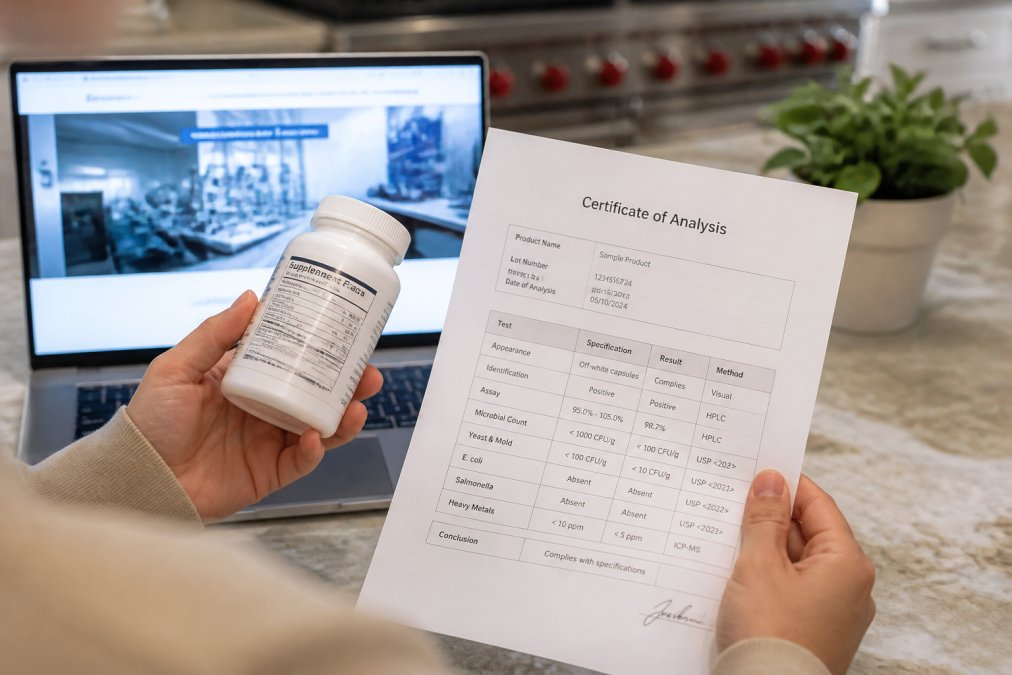
Reading a Certificate of Analysis (CoA)
A Certificate of Analysis (CoA) is a formal lab report documenting test results for a specific batch. It's the paper trail behind every serious quality claim, and most buyers never ask to see one.
Here's what a usable CoA includes:
- Batch or lot number that matches the bottle in your hand
- Identity testing confirming the ingredient is what it claims to be
- Potency verification showing the actual amount of each active compound
- Heavy metal screening for lead, arsenic, cadmium, and mercury
- Microbial testing for bacteria, yeast, and mold
- The testing laboratory's name and the date of analysis
If a company can't produce a CoA for a specific lot number, that's your answer. Skip the product.
How to Actually Read a CoA (Not Just Request One)
Most guides stop at "ask for the CoA." The real skill is interpreting the numbers once you have it.
1. Confirm the header matches your bottle. The CoA should list the product name, lot number, manufacture date, and testing date. Cross-check the lot number against the stamp on your bottle, if they don't match, the report is irrelevant.
2. Find the specification and result columns. A well-built CoA has three columns per test: the specification (what the brand requires), the result (what the lab measured), and a pass/fail call. A report showing only a result with no specification is incomplete, you can't know whether the number is acceptable.
3. Read potency as a percentage of label claim. If the label says 500 mg and the CoA reads 487 mg, that's 97.4% of claim. Industry convention generally accepts roughly 90-110% of label claim as passing, though the window depends on the ingredient and the brand's specification (usp.org). A result at 72% of claim is a fail, even if the report doesn't say so in red letters.
4. Check heavy metals against a recognized limit. CoAs typically report lead, arsenic, cadmium, and mercury in parts per million (ppm) or micrograms per gram (µg/g). Rather than memorizing thresholds, look for the specification the brand set and whether the result falls below it. A brand that sets its own lead limit at 0.5 ppm and reports 0.1 ppm is demonstrating a tighter standard than the regulatory floor. A brand that reports a number with no stated limit is telling you it doesn't have one.
5. Look for the method, not just the result. A credible CoA names the analytical method, HPLC for potency, ICP-MS for heavy metals, or GC-MS for volatile compounds. Method matters because different techniques have different detection limits: a heavy metal screen run by a less sensitive method may read "none detected" simply because the instrument couldn't see low levels.
6. Verify the lab is real and independent. Search the testing laboratory's name. It should be an ISO/IEC 17025-accredited facility, the international standard for testing and calibration competence (NIST Quality System | NIST). If the "lab" shares an address, phone number, or corporate parent with the brand, it isn't third-party, it's in-house testing wearing a lab coat.
Which Certifications Actually Carry Weight
Not all seals are equal. Some represent independent audits; others are logos a brand designed itself.
| Certification | What It Verifies | Who Audits |
|---|---|---|
| NSF Certified for Sport | Banned substances, label accuracy, facility inspection | NSF International |
| USP Verified | Potency, purity, dissolution, manufacturing standards | United States Pharmacopeia |
| Informed Choice | Contaminants and banned substances in sport | LGC Group |
| ConsumerLab Approved | Independent product testing and review | ConsumerLab.com |
| GMP registration | Facility meets manufacturing standards | FDA-registered, third-party audited |
A logo with no auditing body, no cited standard, and no lookup database is decoration. Check that the certifying organization maintains a searchable list of approved products, then search for the brand by name.
NSF certified product lookup database
How to Read Supplement Labels Without Getting Fooled
Learning how to read supplement labels takes about five minutes. The front of the package is advertising; the back panel is the contract.
Start with the Supplement Facts panel. Ingredients are listed by weight, in descending order. If a headline ingredient appears last on a long list, it's present in trace amounts, regardless of how large it's printed on the front.
Then check three things:
- Serving size. A bottle claiming "60 servings" of a two-capsule dose means 120 capsules, not 60.
Spotting Proprietary Blend Traps
Wellness Product Ingredient Transparency and Sourcing
A few questions worth asking before you buy:
Red Flags That Separate High Quality Wellness Brands From Marketing Hype
Warning signs:
Green flags:
How Storage and Shelf Life Affect Product Quality
Why Ingredients Degrade, The Mechanism
What to Check Before You Buy
The Supply-Chain Gap Nobody Audits
Once It's Yours
Frequently Asked Questions
What certifications should I look for when buying wellness products?
Look for NSF Certified for Sport, USP Verified, or Informed Choice seals. These mean an independent lab has tested the product for label accuracy, heavy metal screening, and potency verification. Good Manufacturing Practices (GMP) registration from NSF or UL also matters. A brand that publishes its third-party testing results openly is giving you the strongest signal that its products match what the label claims.
Why is third-party supplement testing important for wellness brands?
The FDA does not test supplements before they reach shelves. Third-party supplement testing fills that gap by checking label accuracy, contaminant analysis, and potency verification. Without it, a bottle could contain less of the active ingredient than advertised, or trace heavy metals. Brands that invest in independent laboratory testing and share those results are showing they prioritize consumer safety over cost savings.
How do I read a supplement label to spot low-quality products?
Start with the Supplement Facts panel. Look for specific amounts of each ingredient. If you see 'proprietary blend' without individual amounts, that is a red flag. Check for standardized extracts that guarantee a certain percentage of bioactive compounds. Also scan for fillers, artificial colors, and vague terms like 'herbal matrix.' A clean label lists every ingredient with a clear purpose and amount.
What red flags should I avoid when choosing a wellness brand?
Watch for health claims that promise to cure or treat diseases, missing contact information, no physical address, and zero third-party testing documentation. Be skeptical of 'proprietary blends' that hide ingredient amounts, prices that seem too low for the ingredients listed, and brands that rely only on customer testimonials without lab reports. High quality wellness brands welcome scrutiny and publish their testing data.
How can I verify the quality of supplements and wellness items?
Check the brand's website for a Certificate of Analysis (CoA) for each product. Look for a batch number on the bottle and match it to a published CoA. Search the FDA's warning letter database for the brand name. You can also check whether the facility is registered with NSF or UL for Good Manufacturing Practices. If a brand cannot provide batch testing results, that tells you something important.
Are there reliable databases for checking wellness brand transparency?
Yes. The NSF International website lets you search certified products. USP has a verified products directory. The FDA publishes warning letters and recall notices. ConsumerLab.com independently tests supplements and publishes results. The NIH Office of Dietary Supplements offers fact sheets on ingredient safety. These resources help you move past marketing buzzwords and see whether a brand has real third-party verification.