


Table of Contents
- Step 1: Cool Down and Start Active Recovery Right After Training
- How to Relieve Muscle Soreness After Lifting: A Step-by-Step Routine
- Best Supplements for Muscle Recovery: What the Evidence Supports
- How Long Does Muscle Recovery Take? Timelines by Training Type
- Sleep, Hydration, and Electrolytes: The Recovery Basics Most Athletes Skip
- Wearable Tech and Psychological Recovery: Two Angles Most Athletes Ignore
- Recovery for Athletes Over 40: Adjusting the Plan as You Age
- Frequently Asked Questions
Last Updated: September 14, 2026
Step 1: Cool Down and Start Active Recovery Right After Training
Fast acting muscle recovery for athletes begins in the ten minutes after the last rep. A structured cool-down is the highest-use habit for reducing next-day soreness.
The goal: bring your heart rate down gradually and restore blood flow to working tissue. Skipping this and heading straight to the locker room is a common mistake.
Here's the sequence that works:
- Walk or cycle at low intensity for 5-8 minutes
- Perform dynamic stretching for the muscles you just trained
- Rehydrate with water or an electrolyte drink
- Refuel with protein and carbohydrates within 60 minutes
How to Relieve Muscle Soreness After Lifting: A Step-by-Step Routine
The most effective way to relieve muscle soreness after lifting is to combine light movement, soft tissue work, and consistent sleep. No single technique eliminates delayed onset muscle soreness, or DOMS, but stacking small habits shortens the timeline.
Soreness is not a sign of a good workout. It's a sign of unfamiliar stress, and it fades as your body adapts. That tells you what to do: reduce the novelty and manage the inflammation, not chase the pain.
What Is Actually Happening in a Sore Muscle
DOMS peaks roughly 24 to 72 hours after training, driven by mechanical damage to muscle fibers from eccentric loading (the lowering phase of a lift) and the inflammation that follows (pubmed.ncbi.nlm.nih.gov). That inflammation is not the enemy: it recruits immune cells that clear damaged tissue and signal repair. Keep it productive, don't shut it down.
The two biggest mistakes are opposite errors: doing nothing (blood flow stays low, stiffness lingers) and doing too much (fresh damage on top of unrepaired tissue). The routine below threads that line.
The Day-After Routine, With Timing and Dosage
- Minutes 0-15: Light movement. Walk, cycle, or swim at a conversational pace for 10-15 minutes. Target a mild sweat, not a workout, to raise blood flow and temperature without adding eccentric load.
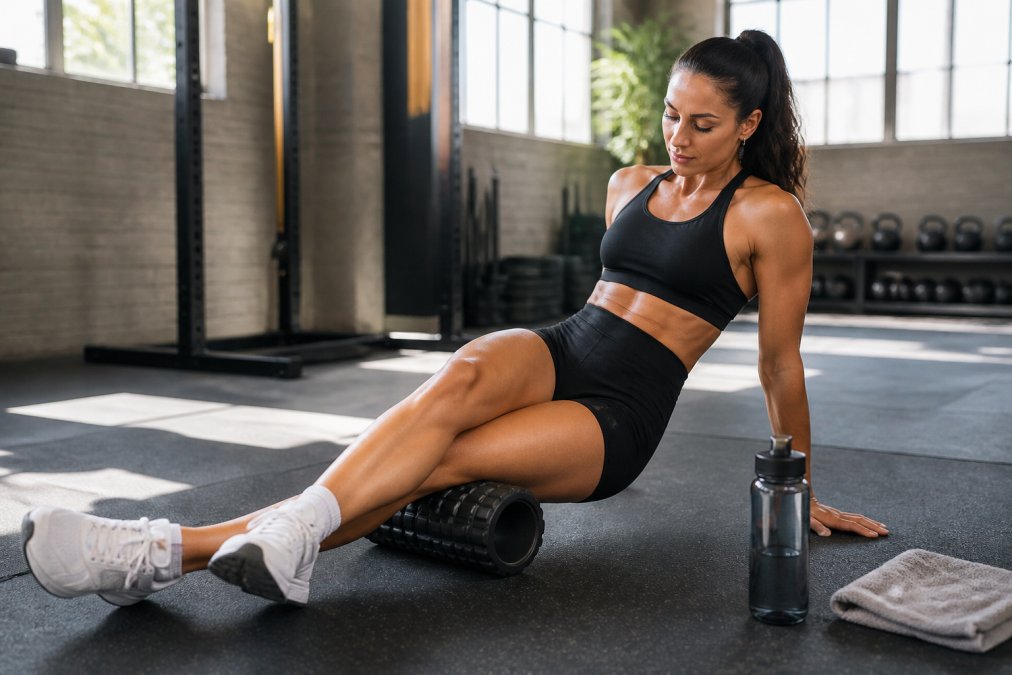
- Minutes 15-30: Foam roll the sore area. Spend 1-2 minutes per muscle group, rolling slowly enough to feel the tissue release. Skip aggressive grinding; if a spot is sharp rather than achy, move off it.
- Minutes 30-40: Dynamic mobility. Leg swings, hip circles, controlled lunges, and arm circles through a full but comfortable range. Hold nothing longer than a few seconds. Save long static holds for later in the day.
- Post-session: Topical relief if needed. A fast-absorbing cream on tight, achy spots takes the edge off without greasy residue that ruins sleep or training clothes.
- That night: 7-9 hours of sleep. This is the step that actually repairs tissue. Growth hormone release and muscle protein synthesis do the real work while you're unconscious.
Why Sleep Outranks Every Gadget on This List
If you only do one thing from this routine, sleep. Athletes who sleep seven to nine hours report less soreness and recover faster than those who add every recovery gadget but sleep five (Sleep and Athletic Performance). Tissue repair, glycogen replenishment, and central nervous system recovery are all concentrated during deep sleep. No foam roller, ice bath, or cream substitutes for it.
Foam Rolling, Dynamic Stretching, and Mobility Drills That Work
Foam rolling increases blood flow and can temporarily reduce tightness. It does not break up scar tissue, despite what you may have read. Think of it as calming the nervous system before mobility work, not a cure.
Dynamic stretching and mobility drills come next. Leg swings, hip circles, and controlled lunges prepare tissue for movement without prolonged stretches that leave muscles feeling weak.
A common mistake is rolling aggressively on already-inflamed tissue. If an area is genuinely painful rather than sore, back off and give it time.
When Soreness Is Not Soreness
Normal DOMS is symmetrical, dull, and improves with gentle movement. See a doctor if you have severe swelling, dark or cola-colored urine, weakness that does not improve, or pain that worsens over several days. Those can signal rhabdomyolysis or another medical issue, not a training problem.
For athletes dealing with sensitive skin, greasy balms can be a dealbreaker. A fast-absorbing formula like Nirvana Magic Cream is designed to soothe muscle aches without leaving residue, which matters when you're applying it before bed or under training clothes.

Best Supplements for Muscle Recovery: What the Evidence Supports
The best supplements for muscle recovery are the ones with real research behind them, not the ones with the loudest marketing. Three stand out: omega-3 fatty acids, magnesium, and creatine monohydrate.
Each supports a different part of the recovery process, and none work overnight. Consistency over weeks moves the needle.
| Supplement | Primary Role | Typical Timing | Best For |
|---|---|---|---|
| Omega-3 fatty acids | Inflammation reduction, tissue repair | With meals | Joint and muscle support |
| Magnesium | Muscle relaxation, sleep quality | Evening | Cramping, poor sleep |
| Creatine monohydrate | Energy restoration, strength | Any time, daily | Strength athletes |
Omega-3s, Magnesium, and Creatine Monohydrate
Omega-3s support inflammation reduction and tissue repair, so many athletes take them daily rather than only after hard sessions. A high-potency EPA and DHA formula such as Nirvana Omega-3 Capsules delivers both in a single softgel.

Magnesium supports muscle relaxation and sleep quality, and many active adults fall short on it. Take it in the evening if sleep is part of your recovery problem.
Creatine monohydrate remains the most studied supplement in sports nutrition, helping restore energy stores between efforts and supporting strength over time (ods.od.nih.gov). Its evidence is stronger than for branched-chain amino acids, which most people get enough of through food.
How Long Does Muscle Recovery Take? Timelines by Training Type
Muscle recovery time depends on training type and intensity, not willpower. Light sessions may resolve in a day; heavy eccentric work can take several days.
Here's a rough guide:
- Light cardio or mobility work: 24 hours or less
- Moderate resistance training: 24-48 hours
- Heavy lifting or new movements: 48-72 hours
- Maximal eccentric work: up to 5-7 days
These timelines assume adequate sleep, hydration, and nutrition; cut any and recovery stretches longer. If soreness persists beyond a week or comes with dark urine or severe swelling, that's a medical issue needing a doctor's attention.
Sleep, Hydration, and Electrolytes: The Recovery Basics Most Athletes Skip
Restorative sleep is when most tissue repair happens. Growth hormone release, muscle protein synthesis, and central nervous system recovery all depend on it. Athletes who sleep five hours and train hard are borrowing against tomorrow. Optimizing these nocturnal physiological processes often requires a foundation of consistent rest, though integrating natural recovery supplements can provide the necessary support to bridge the gap between intense exertion and complete physical restoration.
Hydration matters just as much. Even mild dehydration reduces blood flow and slows nutrient delivery to working muscle. Electrolyte balance supports nerve function and muscle contraction, and heavy sweating disrupts it easily.
This is where a daily hydration habit beats a reactive one. A wellness drink like Nirvana Thrive Wellness Drink supports hydration and energy without the crash that comes with high-sugar sports drinks.

Sleep hygiene basics that actually help:
- Keep a consistent bedtime, even on rest days
- Keep the room cool and dark
- Avoid caffeine after early afternoon
- Put screens away 30 minutes before bed
Wearable Tech and Psychological Recovery: Two Angles Most Athletes Ignore
Wearable technology has changed how athletes track recovery, and it's the angle most guides skip. Heart rate variability, resting heart rate, and sleep scores give objective signals about whether your body is ready for another hard session. The catch: the data is only useful if you act on it.
Reading HRV Without Overreacting to It
Heart rate variability measures the variation in time between heartbeats. Higher variability generally reflects a nervous system that is parasympathetic-dominant, meaning recovered and ready. Lower variability points toward sympathetic dominance, meaning stressed or under-recovered.
The number is meaningless in isolation; what matters is your personal baseline. Most wearables establish a rolling baseline over two to four weeks and flag deviations. A drop of roughly 10 to 20 percent below your normal range, paired with an elevated resting heart rate, is a reasonable signal to swap a hard session for an easy one.
A practical way to use it:
- Track HRV at the same time each morning, ideally right after waking
- Compare today's reading to your own 7-day and 30-day averages, not to a friend's number
- Treat a single low reading as information, not a verdict. Two or three consecutive low days is the pattern worth acting on
- Pair HRV with how you actually feel. If the data says rest and you feel great, a light session is fine. If the data says go and you feel wrecked, trust your body
Sleep and Readiness Scores: Useful, With Limits
Sleep trackers estimate time in bed, time asleep, and time in each sleep stage. They're directionally useful for spotting trends, like a stretch of short nights or a drifting bedtime, but less accurate on any single night, so don't reorganize training around one bad score.
The readiness scores many platforms produce combine HRV, resting heart rate, sleep, and sometimes respiratory rate into a single number. Treat it as a conversation starter, not a command. The value is in the trend line over weeks, not the daily verdict.
Psychological Recovery: The Nervous System Side of Repair
Psychological recovery matters as much as the physical side, and it's even less discussed. Stress raises cortisol, and chronically elevated cortisol slows tissue repair, disrupts sleep, and blunts the adaptations you're training for. Mental fatigue from work, travel, or life stress shows up in performance whether you acknowledge it or not.
The mechanism isn't mysterious. Your nervous system has two modes: sympathetic (fight or flight) and parasympathetic (rest and digest). Hard training, a stressful job, poor sleep, and constant screen time all push you toward sympathetic. Recovery happens when you spend enough time parasympathetic. If you never get there, you never fully recover, no matter how good your nutrition is.
Practical steps that help:
- Take one full rest day per week with no training
- Use a short breathing exercise before bed. Slow breathing at roughly six breaths per minute for five minutes shifts the nervous system toward parasympathetic
- Separate hard training from high-stress workdays when you can
- Protect a wind-down window in the evening: dim lights, no intense work, no arguments
- Get outside for daylight early in the day to anchor your circadian rhythm
Recovery for Athletes Over 40: Adjusting the Plan as You Age
Recovery for athletes over 40 isn't about doing less. It's about adjusting the plan to how the body responds now. Muscle protein synthesis slows with age, sleep quality often declines, and joints need more warm-up time.
The fundamentals still work. They just need more consistency and slightly longer timelines.
What changes most:
- Warm-ups get longer, not shorter
- Protein intake matters more at every meal
- Sleep becomes non-negotiable rather than optional
- Joint support moves from afterthought to priority
Many athletes in this group find a topical cream for achy joints, paired with an omega-3 supplement and better sleep, covers most of what they need. Not glamorous, but it works.
Frequently Asked Questions
What do athletes take to recover faster?
Most evidence-backed options are simple. Creatine monohydrate supports muscle protein synthesis and reduces markers of damage. Omega-3 fatty acids with EPA and DHA help manage inflammation. Magnesium supports muscle relaxation and sleep quality. Many athletes also use a topical cream like Nirvana Magic Cream ($29.99) for fast, localized relief from soreness and tightness. Pair supplements with protein, carbs, and fluids within a few hours of training for the best results.
Can muscles recover in 24 hours?
It depends on the training load. Light sessions with minimal eccentric stress can clear soreness in 24 to 48 hours. Heavy lifting or unfamiliar movements often cause delayed onset muscle soreness (DOMS) that peaks at 24 to 72 hours. Full tissue repair and glycogen replenishment usually take longer than the soreness lasts. Sleep, protein intake, and active recovery like walking or easy cycling can shorten the timeline, but no method makes a hard session disappear overnight.
What are the best natural ways to reduce delayed onset muscle soreness (DOMS)?
Light movement is the most reliable. A 10 to 20 minute walk, easy swim, or stationary bike ride increases blood flow and helps lactate clearance without adding damage. Foam rolling and dynamic stretching reduce tightness. Getting 7 to 9 hours of restorative sleep supports tissue repair and cortisol management. Staying hydrated with electrolytes supports blood flow and nutrient delivery. Omega-3s from a supplement like Nirvana Omega-3 Capsules ($29.97) can also help manage inflammation over time.
Does active recovery work better than passive rest?
For most athletes, yes. Active recovery at low intensity improves blood flow circulation, helps clear metabolic byproducts, and reduces stiffness compared with lying still. Passive rest still has a place after very heavy or damaging sessions, and sleep remains the single most important recovery tool. A practical approach: use active recovery on the day after training, and reserve full rest for when you feel central nervous system fatigue, joint pain, or signs of overtraining syndrome.