


Table of Contents
- Understanding Postpartum Hair Loss and the Postpartum Hair Care Routine You Need
- Step 1: Choose the Best Shampoos for Postpartum Hair Loss
- Step 2: Master Gentle Cleansing Techniques for Hair Retention
- Step 3: Implement Scalp Massage for Hair Growth Postpartum
- Step 4: Apply Natural Oils and Postpartum Hair Growth Tips
- Step 5: Avoid Styling Damage and the Mom Bun Trap
- Step 6: Support Hair Regrowth With Nutrition and Supplements
- Step 7: Address the Mental Health Connection to Hair Health
Last Updated: July 28, 2026
Understanding Postpartum Hair Loss and the Postpartum Hair Care Routine You Need
Many new mothers experience significant hair shedding within weeks of delivery, a condition called telogen effluvium. At Nirvana Wellness Store, we understand how distressing this can be. Hair loss after pregnancy isn't permanent, it's a predictable response to hormonal shifts. During pregnancy, elevated estrogen keeps more hair in the growth phase. After delivery, estrogen levels plummet, signaling those extra hairs to enter the shedding phase simultaneously. This guide walks you through seven evidence-based steps to minimize hair loss and support regrowth during this delicate postpartum phase.
What Causes Postpartum Hair Loss
Postpartum hair loss stems from hormonal fluctuation. After birth, estrogen drops sharply, triggering a synchronized shift into the telogen (shedding) phase, which explains why you might notice increased hair in your shower drain starting 2-4 weeks postpartum. Some mothers report losing 100-150 hairs daily during peak shedding, compared to the normal 50-100. Additional factors amplify postpartum hair loss: nutrient depletion from pregnancy and breastfeeding (iron, zinc, B vitamins), sleep deprivation increasing cortisol, postpartum thyroiditis affecting 5-10% of new mothers, and tight hairstyles triggering tension alopecia.
When Does Postpartum Hair Loss Stop
Most mothers experience peak hair shedding between 3-6 months postpartum, with noticeable improvement by month 9-12. If you're exclusively breastfeeding, hormonal recovery takes longer. Mothers with adequate iron and protein stores recover faster than those with deficiencies.
Here's what to expect:
- Weeks 2-8: Shedding begins; increased hair loss during washing and styling
- Months 2-6: Peak shedding period
- Months 6-12: Gradual slowdown; new hair growth becomes visible
- Month 12+: Hair cycle returns to normal; most mothers see full recovery by 18-24 months
If hair loss persists beyond 12 months or worsens after initially improving, consult a dermatologist.
Step 1: Choose the Best Shampoos for Postpartum Hair Loss
The best shampoos for postpartum hair loss are sulfate-free and specifically formulated to add volume without stripping moisture. Sulfates are harsh detergents that strip natural oils from the scalp and hair shaft, leaving strands brittle and prone to breakage. Sulfate-free shampoos clean effectively without disrupting the hair's protective cuticle layer, preserving natural sebum, the scalp's built-in conditioner.
Look for these ingredients in postpartum-safe shampoos: biotin and keratin to strengthen hair structure, niacin (vitamin B3) to improve scalp circulation, panthenol for lightweight moisture, plant proteins to coat and protect strands, and essential oils like rosemary or peppermint to stimulate scalp health.
The Nirvana Hair Growth Oil works alongside sulfate-free shampoos to amplify results. Applied to damp hair after shampooing, it provides targeted nourishment to the scalp and mid-lengths without heaviness. At $34.99 for 2oz, it's designed specifically for postpartum hair support.
Step 2: Master Gentle Cleansing Techniques for Hair Retention
How you wash your hair matters as much as what you use. Aggressive cleansing techniques accelerate postpartum hair loss by mechanically stressing already-weakened strands.
Use the "scalp massage" cleansing method instead of traditional scrubbing:
- Wet hair thoroughly with lukewarm water for 30-60 seconds
- Apply shampoo to the scalp only, not the full length of hair
- Use fingertips, not nails: Place all five fingertips on the scalp and move in small, circular motions
- Work systematically: Cover the entire scalp, spending 60-90 seconds total
- Rinse completely with cool water, ensuring no shampoo residue remains
- Avoid wringing or twisting wet hair; gently squeeze water from mid-lengths to ends
This method cleanses the scalp while protecting the hair shaft from mechanical stress. The circular massage motion also stimulates blood flow to follicles, supporting hair health.
| Technique | Breakage Risk | Scalp Cleansing | Frequency |
|---|---|---|---|
| Vigorous scrubbing with nails | High | Excellent | 2-3x weekly |
| Fingertip massage method | Low | Very good | 2-3x weekly |
| Co-washing (conditioner only) | Very low | Moderate | 1-2x weekly |
| Dry shampoo | None | Moderate | Between washes |
Dry shampoo becomes your friend when stretching time between washes. Sprinkle it on the scalp the night before or morning of your next wash to absorb excess oil and extend the time between full washes, reducing overall cleansing stress on vulnerable hair.
Step 3: Implement Scalp Massage for Hair Growth Postpartum
Scalp massage stimulates blood flow to the scalp, delivering oxygen and nutrients directly to follicles. This supports the transition from telogen (shedding) back to anagen (growth) phase. Regular scalp massage can increase hair thickness and follicle health measurably. The practice takes just 5-10 minutes daily and requires no products or special equipment.
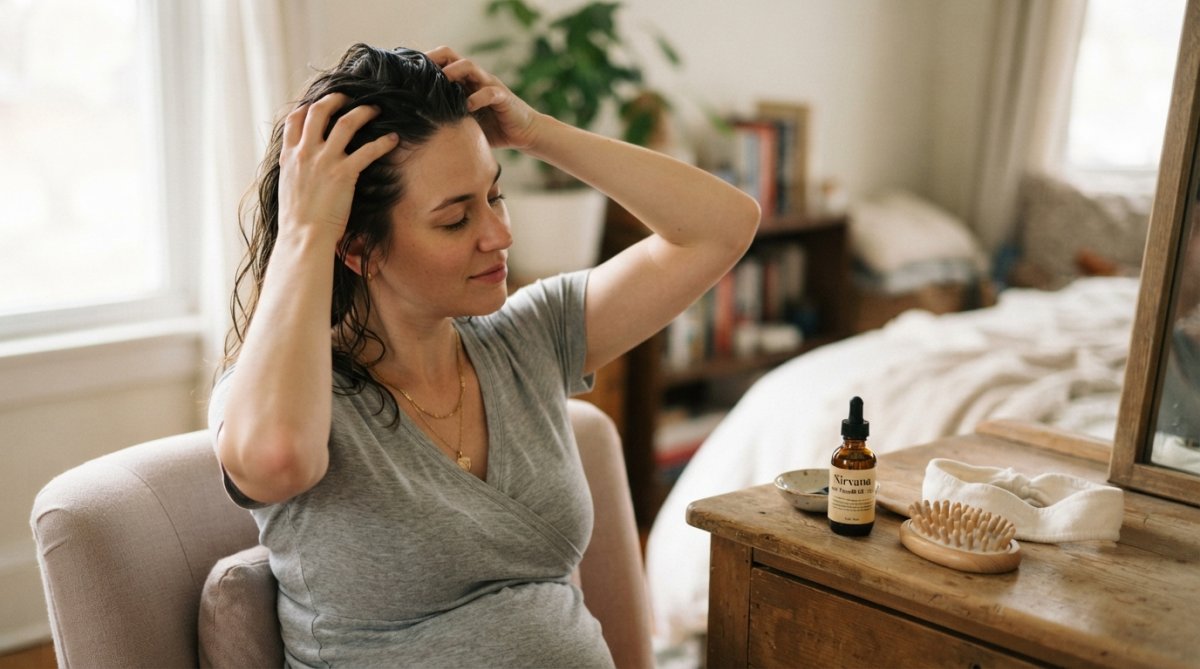
The Daily Scalp Massage Routine (5 minutes):
- Sit comfortably in a quiet space
- Use all five fingertips on both hands, placing them flat against the scalp
- Apply moderate pressure, firm enough to feel the scalp move slightly
- Move in small circles at each point, spending 10-15 seconds per area
- Work systematically: Start at the hairline and move backward toward the crown, then cover the sides and back
- Repeat the pattern 2-3 times, covering the entire scalp
Scalp Massage with Nirvana Hair Growth Oil (10 minutes, 2-3x weekly):
For deeper nourishment, combine massage with the Nirvana Hair Growth Oil. Warm the oil slightly between your palms, apply to the scalp in sections, use the same massage technique, allow the oil to sit for 5-10 minutes after massage, then shampoo gently to remove excess oil. The Double Pack option ($64.99) is ideal for mothers who want to maintain consistency without frequent reordering.
Step 4: Apply Natural Oils and Postpartum Hair Growth Tips
Natural oils provide targeted nourishment to the scalp and hair during postpartum recovery. Unlike heavy conditioners, quality oils absorb into the scalp to support follicle health while coating the hair shaft to reduce breakage.
Argan Oil is rich in vitamin E and antioxidants that protect follicles from oxidative stress. Apply a few drops to the scalp 2-3 times weekly, massage gently, and leave for at least 30 minutes before shampooing. Coconut Oil contains lauric acid, which penetrates the hair shaft to reduce protein loss during washing, but use it sparingly on fine or thin hair.
Nirvana Hair Growth Oil combines botanical extracts specifically formulated for postpartum hair support. Unlike single-ingredient oils, this blend targets multiple aspects of postpartum hair loss: scalp health, follicle stimulation, and strand strength. The 2oz bottle ($34.99) lasts 4-6 weeks with 2-3 weekly applications.
How to Use Natural Oils in Your Postpartum Hair Care Routine:
- Scalp oil treatment: Apply 2-3 times weekly, 30-60 minutes before shampooing
- Pre-shampoo protection: Coat the mid-lengths and ends 5 minutes before shampooing to reduce breakage during cleansing
- Overnight treatment: Use a lighter oil and sleep with a silk pillowcase to prevent transfer to bedding
- Leave-in serum: After shampooing, apply 1-2 drops to damp ends for lightweight moisture
Applying oil immediately before shampooing (5-10 minutes) protects hair during cleansing. Applying oil 30-60 minutes before shampooing allows deeper scalp penetration and follicle support.
Step 5: Avoid Styling Damage and the Mom Bun Trap
New mothers often resort to tight hairstyles out of necessity, but tight hairstyles during postpartum hair loss create tension alopecia, where constant pulling stresses follicles and accelerates shedding. The solution is choosing low-tension alternatives and protecting hair from heat and styling damage.
Avoid heat styling during postpartum recovery. Heat opens the hair cuticle and accelerates moisture loss from already-vulnerable strands. If you must use heat, use a heat protectant spray and set your blow dryer to the lowest heat and speed settings.
Air-drying is your best friend. After shampooing, gently squeeze water from hair, wrap it loosely in a microfiber towel or t-shirt for 10-15 minutes, then let it air-dry. Use a wide-tooth comb to gently detangle while damp, never while wet.
Low-tension hairstyles for postpartum mothers:
- Loose braid: Braid hair loosely at the crown, leaving plenty of slack
- Half-up clip: Gather only the top half of hair loosely and secure with a soft claw clip or silk scrunchie
- Loose ponytail: Position the elastic low on the back of your head with enough slack to fit two fingers inside
- Headband or scarf: Wrap soft fabric around your hairline without tension
- Pineapple method: Gather hair loosely on top of your head before bed to minimize friction overnight
Avoid tight buns, tight ponytails pulled high on the head, cornrows, tight braids, extensions, and rubber bands. Use silk scrunchies instead.
Step 6: Support Hair Regrowth With Nutrition and Supplements
Postpartum hair loss accelerates when your body lacks the nutrients follicles need to sustain growth. Pregnancy depletes iron, zinc, B vitamins, and protein, all critical for hair health. Breastfeeding continues this depletion. Supplementation becomes essential during postpartum recovery.
Biotin is a B vitamin that supports keratin production. Studies show biotin supplementation can improve hair strength and reduce shedding. The typical postpartum dose is 2.5-5mg daily. Iron is critical, especially if you're breastfeeding. Ask your doctor to test your ferritin levels. If low, iron supplementation at 27-30mg daily, taken with vitamin C, is essential. Zinc supports follicle health at 8-11mg daily. Vitamin D supports follicle health and mood at 1000-2000 IU daily. Omega-3 fatty acids reduce scalp inflammation at 1-2 grams daily.
| Nutrient | Best Sources | Postpartum Benefit |
|---|---|---|
| Iron | Red meat, spinach, lentils, fortified cereals | Prevents deficiency-related hair loss |
| Zinc | Oysters, beef, pumpkin seeds, chickpeas | Supports follicle health and recovery |
| Biotin | Eggs, almonds, sweet potatoes, salmon | Strengthens new hair growth |
| Collagen | Bone broth, chicken skin, fish | Supports hair structure and scalp |
| Vitamin D | Fatty fish, egg yolks, mushrooms, sunlight | Follicle health and mood |
| Omega-3 | Salmon, sardines, walnuts, flax seeds | Reduces scalp inflammation |
Start supplementation at 6-8 weeks postpartum, when shedding typically peaks. Most supplements take 8-12 weeks to show results because they affect new hair growth. Take biotin, collagen, and other supplements with food to improve absorption. Iron is an exception, take it on an empty stomach for maximum absorption, but if it causes nausea, take it with a light meal.
Step 7: Address the Mental Health Connection to Hair Health
Postpartum hair loss carries an emotional weight beyond the physical loss of hair. Many mothers experience anxiety, grief, or depression triggered by visible hair loss during an already vulnerable postpartum period. This emotional stress paradoxically worsens hair loss through elevated cortisol.
Elevated cortisol (the stress hormone) pushes hair prematurely into the telogen (shedding) phase. New mothers often experience high cortisol from sleep deprivation, anxiety about infant care, hormonal shifts, and identity loss. This physiological stress accelerates postpartum hair loss beyond what hormones alone would cause.
Practical mental health strategies that support hair health:
- Normalize the experience: Postpartum hair loss affects most mothers. You're not alone, and it's temporary.
- Set realistic expectations: Hair won't regrow overnight. New hair takes 3-6 months to become visible.
- Prioritize sleep: Sleep deprivation elevates cortisol and worsens hair loss. Even small improvements in sleep quality measurably reduce stress-driven shedding.
- Practice scalp massage as meditation: The 5-10 minute daily scalp massage serves double duty, it stimulates follicles and provides a grounding self-care moment that reduces cortisol.
- Limit mirror checking: Constantly checking for hair loss increases anxiety and cortisol. Check your hair once weekly, not multiple times daily.
- Talk to a therapist if needed: Postpartum anxiety and depression are real and common. Professional support helps both your mental health and your hair recovery.
Supporting your postpartum hair recovery requires a multi-faceted approach that addresses hormonal shifts, nutritional depletion, and the stress of early motherhood. The seven steps outlined here work together to minimize hair loss and support regrowth during this critical window.
At Nirvana Wellness Store, we've designed the Nirvana Hair Growth Oil specifically for mothers navigating postpartum hair loss. The botanical formula supports scalp health and follicle stimulation without heaviness. Whether you choose the single 2oz bottle ($34.99) or the Double Pack for consistent support ($64.99), you're investing in a routine that works with your body's natural recovery process.
Your postpartum hair care routine becomes easier when you work with your biology, not against it. Consistency matters more than perfection. Small daily actions compound into visible hair retention and regrowth over weeks and months. Trust the process, be patient with yourself, and remember that postpartum hair loss is temporary. Your hair will return to normal density with the right support.
American Academy of Dermatology on postpartum hair loss and telogen effluvium
National Institutes of Health research on biotin and hair health
Mayo Clinic guide to postpartum recovery and nutritional needs
Frequently Asked Questions
When does postpartum hair loss usually start and stop?
Postpartum hair loss, or telogen effluvium, typically begins 2-3 months after delivery as hormonal shifts trigger follicles to enter a resting phase. Hair shedding peaks around 4-5 months postpartum and generally resolves within 6-12 months as hormone levels stabilize. If hair loss persists beyond 12 months or worsens, consult a dermatologist to rule out other conditions.
What are the best shampoos for postpartum hair loss?
Look for sulfate-free, volumizing shampoos that gently cleanse without stripping natural oils. Avoid heavy conditioning shampoos that can weigh down thinning hair. Pair cleansing with scalp stimulation and natural oils like argan oil or coconut oil to support follicle health during postpartum recovery. Consider products specifically formulated to reduce breakage and support hair density.
Can natural oils really help with postpartum hair growth?
Natural oils support scalp health and may reduce breakage when used as part of a consistent postpartum hair care routine. Argan oil and coconut oil are popular choices for nourishing the scalp and improving hair texture. Products like Nirvana Hair Growth Oil ($34.99) combine botanical blends designed to support follicle health. Apply oils 1-2 times weekly, focusing on the scalp and mid-lengths to avoid greasiness at the roots.
Should I be concerned about tension alopecia from wearing my hair in a mom bun?
Yes, tight hairstyles like the mom bun can cause tension alopecia if worn frequently over months. During postpartum hair loss, opt for loose braids, low ponytails, or leave hair down when possible. Avoid pulling hair tightly at the scalp, especially around the hairline where new regrowth is delicate. Alternating styles and giving your scalp regular breaks reduces additional stress on weakened follicles.
This article was written using GrandRanker