


Table of Contents
- Why Room Size Changes Everything for Essential Oil Diffusers
- Essential Oil Diffuser Coverage Area: Square Footage and Beyond
- Ultrasonic vs Nebulizing Diffusers for Large Spaces
- How Long to Run a Diffuser in a Small Bedroom
- Features That Matter for Large Living Spaces vs Small Rooms
- HVAC Integration vs Standalone Units
- Conclusion
- Frequently Asked Questions
Last Updated: September 24, 2026
Why Room Size Changes Everything for Essential Oil Diffusers
Walk into any home goods store and you'll see diffusers marketed by square footage alone. That single number hides the real story. The actual performance of essential oil diffusers for large living spaces versus small rooms depends on room volume, ceiling height, and how air moves through the space, not just floor area. This guide from Nirvana Wellness Store breaks down what actually determines scent throw, so you can match the right unit to the right room instead of guessing.
A 400-square-foot living room with 12-foot ceilings holds nearly twice the air of the same footprint with 8-foot ceilings. That extra air dilutes essential oil concentration fast. Most buyers never account for this, which is why a diffuser that fills a bedroom beautifully can barely register in an open-concept great room.
Below, we'll show you exactly how to size a diffuser to your space, which type works best where, and the features that separate a unit built for large rooms from one designed for a nightstand.
Essential Oil Diffuser Coverage Area: Square Footage and Beyond
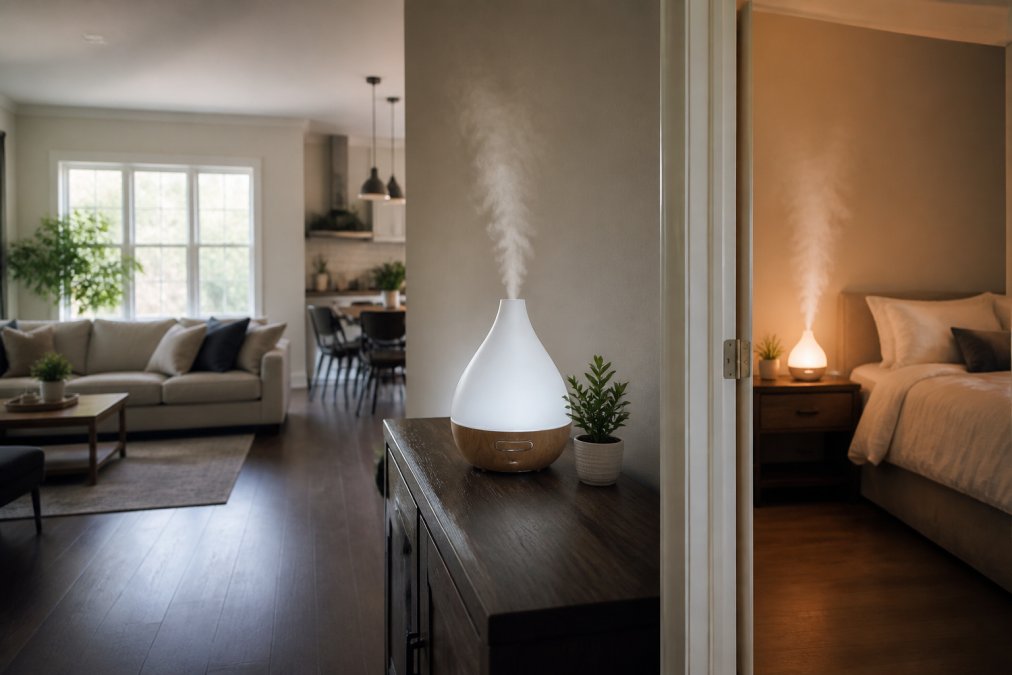
Essential oil diffuser coverage area is the square footage a unit can effectively scent, typically listed between 100 and 1,000 square feet depending on mist output and tank size. But square footage alone is misleading. Manufacturers test coverage in closed rooms with standard 8-foot ceilings, so real-world results vary, sometimes by a factor of two.
The number that actually governs performance is room volume, measured in cubic feet. Multiply length × width × ceiling height. A 400-square-foot living room with 8-foot ceilings holds 3,200 cubic feet of air. The same footprint with 12-foot ceilings holds 4,800 cubic feet, 50% more air for the same mist output to fill.
Here's what actually drives coverage:
- Room volume: Length × width × ceiling height, in cubic feet. This is the real denominator.
- Airflow and ventilation: Open windows, ceiling fans, and HVAC returns pull scent out of the breathing zone. A room with active air exchange can lose a meaningful share of its airborne oil every hour.
- Mist output: Measured in milliliters per hour. A typical compact ultrasonic unit puts out 20-30 mL/hr; a large-room ultrasonic or nebulizer can exceed 100 mL/hr.
- Oil concentration: More drops per tank means stronger scent throw, up to a point. Past roughly 10-15 drops per 100 mL of water, extra oil mostly settles rather than disperses.
A diffuser rated for 500 square feet will struggle in a 500-square-foot room with vaulted ceilings. Treat the rating as a starting point, then size up if your space has high ceilings or open sightlines.
Ceiling Height and Airflow Impact
Ceiling height and airflow are the two variables most coverage charts ignore, and they're the ones that decide whether a diffuser actually works in an open-concept home.
Ceiling height. Air volume scales linearly with ceiling height. Going from 8-foot to 10-foot ceilings adds 25% more air; going to 12-foot ceilings adds 50%. That extra air dilutes essential oil concentration proportionally, so a diffuser that fills a standard-height bedroom beautifully can barely register in a great room with a vaulted ceiling. The practical rule: for every 2 feet of ceiling height above 8 feet, size up roughly one coverage tier.
Airflow. Moving air is the bigger wildcard. A ceiling fan on medium, an open window, or a central HVAC return can move hundreds of cubic feet of air per minute through the room. That air carries mist away from where you're sitting faster than the diffuser can replace it.
Oil Consumption Efficiency: The Cost-Per-Hour Math
Most guides stop at coverage. The variable that actually decides whether a diffuser is practical for daily use is oil consumption efficiency, how much oil it takes to maintain a given scent level for an hour.
Ultrasonic vs Nebulizing Diffusers for Large Spaces
Ultrasonic and nebulizing diffusers are the two main types for large rooms, and they work very differently. Ultrasonic units use a piezoelectric plate vibrating at ultrasonic frequency to break water and oil into a fine mist. Nebulizing diffusers use pressurized air through a narrow nozzle to atomize pure oil with no water at all. A third type, evaporative diffusers, uses a fan to blow air across a wick or pad soaked in oil, releasing scent without mist.
| Feature | Ultrasonic | Nebulizing | Evaporative |
|---|---|---|---|
| Water needed | Yes | No | No |
| Oil use per hour | Lower | Higher | Moderate |
| Scent intensity | Moderate | Strong | Mild |
| Noise level | Quiet hum | Faint pump sound | Fan noise |
| Cleaning | Frequent descaling | Minimal | Replace wick/pad |
| Best for | Bedrooms, medium rooms | Large, open spaces | Small rooms, cars |
Water Tank Capacity and Run Time
Water tank capacity determines how long a diffuser runs before refilling. Small tanks hold 100 to 200 milliliters and run 3 to 6 hours. Large tanks hold 500 milliliters or more and run 10 to 12 hours on continuous diffusion, or longer on intermittent mode.
HVAC Integration vs Standalone Units
This is the angle most diffuser guides skip entirely, and it's the one that matters most for large or multi-room homes.
How Long to Run a Diffuser in a Small Bedroom
Run a diffuser in a small bedroom for 30 to 60 minutes at a time, then turn it off. Small rooms saturate quickly, and continuous diffusion in a closed space can overwhelm the senses and leave residue on surfaces.
A practical routine looks like this:
- Before bed: Run 30 minutes with the door closed to build scent
- Overnight: Use intermittent mode or a timer, never continuous
- Morning: Air the room out before the next session
Running a diffuser continuously in a small, closed bedroom for hours can leave a film of oil on walls, furniture, and bedding. Stick to timed sessions and wipe surfaces near the unit weekly.
Features That Matter for Large Living Spaces vs Small Rooms
The features that matter most shift with room size. Large spaces need adjustable mist output, longer timers, and stronger tanks. Small rooms benefit from quiet operation and low-output settings.
For large living spaces, prioritize:
- Adjustable mist modes: Low, medium, and high output for different times of day
- Long timer settings: 6 to 12 hours for all-day diffusion
- Larger tanks: Fewer refills in high-output use
- Auto-shutoff: Safety when the tank runs dry
For small rooms, prioritize:
- Low noise level: Under 30 decibels for sleep
- Compact footprint: Fits on a nightstand or shelf
- Short timers: 1 to 3 hours to prevent oversaturation
- Auto-shutoff: Same safety benefit, smaller tank
Auto-Shutoff, Timer Settings, and Noise Level
Auto-shutoff turns the unit off when water runs out, protecting the device and preventing overheating. It's non-negotiable for any diffuser you'll run unattended, especially overnight.
HVAC Integration vs Standalone Units
HVAC integration and standalone diffusers serve different purposes. A standalone unit scents one room directly. An HVAC-integrated system disperses scent through your home's ductwork, covering multiple rooms from a single source.
Conclusion
Sizing a diffuser correctly comes down to room volume, airflow, and how you actually use the space. A large living room needs higher mist output and a bigger tank. A small bedroom needs quiet operation and short, timed sessions. Getting that match right is the difference between a diffuser that works and one that sits unused.
Frequently Asked Questions
What size diffuser should I use for a large room?
For a large room, choose a diffuser with a tank capacity of at least 500 ml and a coverage area rating that matches your square footage. Ultrasonic models with 300-500 ml tanks work well for rooms up to 500 square feet, while nebulizing diffusers are better for open-concept spaces over 500 square feet because they do not rely on water and deliver a stronger scent throw. Check the manufacturer's coverage area rating and adjust based on ceiling height and airflow.
Can a small diffuser effectively scent a large living area?
A small diffuser with a 100-200 ml tank will struggle to fill a large living area. The mist output is lower, and the essential oil concentration disperses quickly in a bigger volume of air. You may notice the scent only within a few feet of the unit. For large spaces, use a high-capacity ultrasonic or nebulizing diffuser, or place multiple small units in different zones to maintain consistent fragrance intensity.
How does room square footage affect essential oil diffuser performance?
Square footage determines the volume of air the diffuser must fill. A 300-square-foot room has roughly 2,400 cubic feet of air (assuming 8-foot ceilings), while a 600-square-foot room has 4,800 cubic feet. The diffuser must disperse enough essential oil molecules to reach a noticeable concentration throughout that volume. Higher ceilings and open floor plans increase the effective volume further, so coverage area ratings are a starting point, not a guarantee.
What features should I look for in a high-capacity essential oil diffuser?
Look for auto-shutoff to prevent overheating when the water runs out, timer settings for intermittent or continuous diffusion, and a noise level under 30 decibels for bedrooms. Adjustable mist output helps you control fragrance intensity. For large spaces, prioritize a tank capacity of 500 ml or more and a coverage area rating that exceeds your room's square footage. A nebulizing model is worth considering if you need a strong scent throw without water dilution.