


Table of Contents
- How to Choose the Right Curly Hair Care Products for Your Texture
- Why Sulfate-Free Shampoo for Curly Hair Is Non-Negotiable
- The Best Curl Creams for Definition Without the Crunch
- Must-Have Products for Moisture Retention and Frizz Control
- How to Maintain Curly Hair Naturally With Scalp Health in Mind
- Budget-Friendly vs. Luxury: What Actually Matters in Ingredients
- Conclusion
- Frequently Asked Questions
Last Updated: September 8, 2026
How to Choose the Right Curly Hair Care Products for Your Texture
Curly hair care products are not a one-size-fits-all category, and choosing the wrong formula is the most common reason curls fall flat or turn frizzy. Choosing the wrong formula is the most common reason curls fall flat or turn frizzy. The real work begins with understanding two specific characteristics of your hair: its curl pattern and its porosity. The real work begins with understanding two specific characteristics of your hair: its curl pattern and its porosity.
Curl pattern describes the shape of your strand, typically ranging from loose waves (2A) to tight coils (4C). Porosity refers to how well your hair absorbs and retains moisture, which is the single biggest factor in how products perform on your head. High-porosity hair drinks up moisture quickly but loses it just as fast, while low-porosity hair repels water and requires lighter, more penetrating ingredients.
Identify Your Curl Pattern and Porosity
A simple strand test reveals porosity: place a clean hair in a glass of water. If it floats, you likely have low porosity; if it sinks, high porosity. For curl pattern, examine a freshly washed, air-dried strand without product. This baseline tells you whether to prioritize heavy butters and creams or lightweight gels and mists.
Why Sulfate-Free Shampoo for Curly Hair Is Non-Negotiable
Sulfate-free shampoo for curly hair is not a marketing trend; it is a structural necessity. Sulfates are harsh detergents that strip the scalp of its natural oils, and curly hair is already prone to dryness because those oils struggle to travel down a twisted strand (the FDA). Washing with sulfates leaves curls brittle, dull, and more susceptible to breakage.
A common mistake is assuming any shampoo labeled "gentle" qualifies. Check the ingredient list for sodium lauryl sulfate or sodium laureth sulfate. If either appears near the top, the product will compromise your moisture barrier. Instead, look for cleansing agents derived from coconut or glucose that lift buildup without disrupting the protein-moisture balance your curls depend on.
The Best Curl Creams for Definition Without the Crunch
The best curl creams for definition are those that hold the curl clump together without forming a hard cast. Many styling products rely on polymers like PVP or polyquaternium-4 that dry stiff, creating that crispy feel women often complain about. A quality curl cream should use a balance of emollients (shea butter, jojoba oil, babassu oil) and humectants (glycerin, aloe vera, panthenol) to soften the strand while light-hold agents like hydrolyzed wheat protein encourage the natural curl shape to form.
How Curl Creams Work on the Strand
Curl creams function through three simultaneous actions. First, emollients fill gaps in the raised cuticle to smooth the strand surface. Second, humectants draw moisture from the air into the hair shaft, but this works only when ambient humidity is between 40 and 60 percent (peer-reviewed research). In arid conditions, humectants pull moisture out of the hair instead, which is why a cream that works in summer may leave curls brittle in winter. Third, film-forming polymers create a flexible network around each curl clump, holding the shape without the rigidity of a hard gel cast.
Matching Cream Weight to Curl Type and Porosity
Product weight matters more than brand loyalty. Loose waves (2A-2B) and low-porosity hair need lightweight creams with water as the first ingredient and minimal butter content, look for aloe vera juice or flaxseed gel as the base. Medium curls (3A-3B) with normal porosity perform well with balanced formulas containing shea butter and glycerin in roughly equal measure. Tight coils (3C-4C) and high-porosity hair require heavier creams where shea butter, mango butter, or castor oil appear within the first five ingredients to provide lasting occlusion.
A common pattern among stylists is recommending a cream with protein for heat-damaged or color-treated curls. Hydrolyzed keratin or rice protein temporarily fills gaps in the damaged cuticle, improving curl definition until the healthier new growth arrives. However, protein-sensitive hair, often identified by stiffness or excess frizz after protein use, should stick to protein-free formulas.
Application Technique: Sectioning and the Bowl Method
The difference between defined curls and frizzy chaos often comes down to application, not product choice. Working through soaking-wet hair in four sections, nape, crown, left side, right side, ensures even distribution. Use a dime-to-quarter-sized amount per section depending on density and length. Emulsify the cream between your palms before applying to prevent product clumping.
The bowl method, popularized by curly hair educators, involves dipping sections of wet hair into a bowl of water mixed with a small amount of leave-in conditioner before applying curl cream. This technique keeps the strand saturated while the cream seals the water inside, producing noticeably smoother curl clumps. After applying, cup the ends of your hair and push upward toward the scalp to encourage curl formation. Avoid raking fingers through the hair after product application, this separates curl clumps and invites frizz.
Drying Methods and Product Performance
How you dry affects how the cream performs. Air-drying allows the most moisture retention but can take hours for dense hair. Diffusing on low heat with a bowl attachment speeds drying while preserving curl shape, keep the dryer moving to prevent heat damage to one spot. Plopping with a microfiber towel or cotton t-shirt for 10-15 minutes absorbs excess water without roughing the cuticle. If you are transitioning from heat-damaged hair, expect the pattern to re-emerge gradually over several weeks as the healthier new growth comes in; during this period, a cream with protein and lighter hold will support the emerging curl without weighing it down.
Must-Have Products for Moisture Retention and Frizz Control
Moisture retention and frizz control are two sides of the same problem: keeping water inside the strand where it belongs. Frizz appears when the cuticle lifts and humidity penetrates the hair shaft, causing it to swell and separate. The fix is a routine built around layering humectants, emollients, and occlusives in the right order.
Leave-In Conditioners and Co-Washes
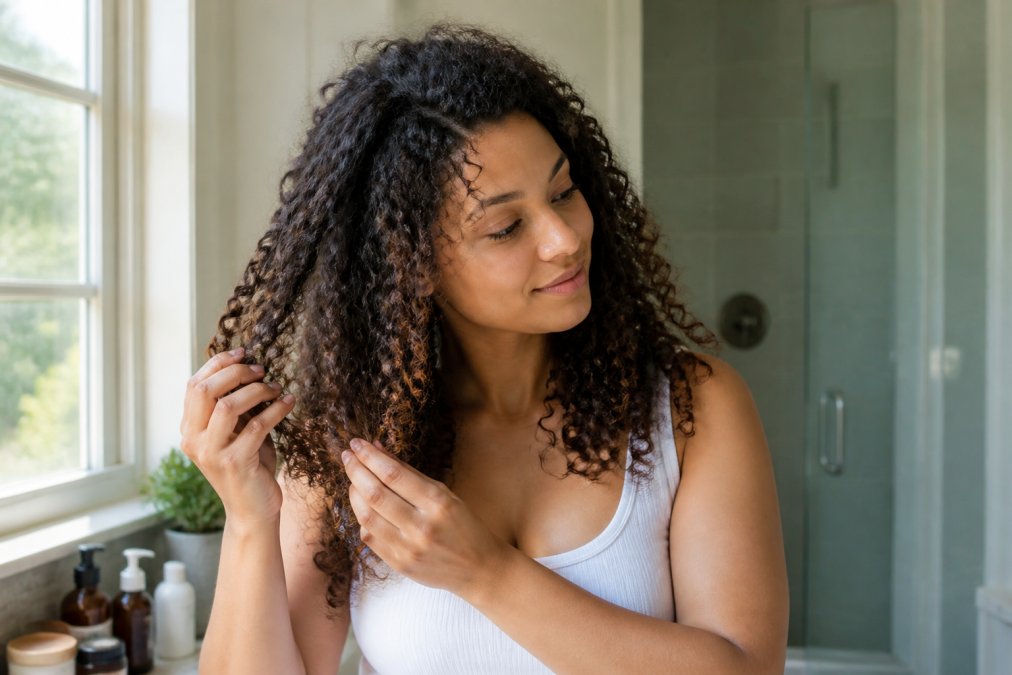
A leave-in conditioner is the foundation of any moisture routine because it provides continuous hydration between washes. Co-washing, or cleansing with conditioner alone, is a technique suited to those with very dry or tightly coiled hair who need to avoid frequent shampooing. A co-wash gently removes buildup while depositing moisture, making it a staple for maintaining healthy curly hair naturally.
For daily maintenance, focus on the ends of your hair where the oldest, driest strands live. Apply a small amount of leave-in and seal it with a few drops of oil to lock in the hydration.
How to Maintain Curly Hair Naturally With Scalp Health in Mind
How to maintain curly hair naturally starts with what most guides overlook: the scalp. Healthy curls grow from a nourished follicle, and an imbalanced scalp produces either excess oil or flaky dryness that migrates down the strand. Treating the scalp with the same care as the lengths of your hair is the difference between temporary styling and lasting hair health.
A weekly scalp massage with a botanical oil improves circulation and helps distribute the scalp's natural sebum. This is where a targeted product earns its place in your routine. The Nirvana Hair Growth Oil at $19.99 is formulated with nutrient-rich botanical oils designed to nourish the scalp and support stronger, fuller strands as part of a consistent hair care routine. For those committed to long-term consistency, the Nirvana Hair Oil - Double Pack at $39.99 ensures you never run out mid-cycle.


Budget-Friendly vs. Luxury: What Actually Matters in Ingredients
The price gap between budget-friendly and luxury curly hair products rarely reflects a difference in the quality of the core ingredients. Both ends of the market use the same fundamental building blocks: water, oils, and humectants. What changes is the concentration of active botanical extracts, the quality of the carrier oils, and the fragrance profile. Understanding where your money actually goes, and where it is wasted, requires looking past the label and examining the formula itself.
The Ingredient Cost Hierarchy
Ingredients fall into three tiers based on their cost to manufacturers. The first tier, water, glycerin, cetyl alcohol, and basic preservatives, costs pennies per ounce and appears in nearly every product regardless of price. The second tier, shea butter, jojoba oil, argan oil, and aloe vera, costs moderately more and appears at varying concentrations. The third tier, cold-pressed botanical oils like marula or baobab, ceramides, peptides, and proprietary plant stem cell extracts, carries premium costs and typically appears only in higher-priced formulations.
A $12 drugstore curl cream and a $48 salon cream may both list shea butter, but the drugstore version might contain it at 2 percent concentration while the salon version uses 15 percent. According to guidance from the FDA on cosmetic labeling, ingredient lists are ordered by concentration, so the first five ingredients tell you what the product is mostly made of. If shea butter appears after the fifth ingredient, it is present primarily for marketing, not function.
Where Budget Formulas Excel
Several mass-market brands have closed the gap with luxury competitors by focusing on simple, effective formulations. Drugstore lines built around glycerin, aloe vera, and coconut-derived cleansers often outperform mid-tier salon brands that pad formulas with synthetic polymers and fragrance. The most reliable budget purchases are shampoos and conditioners, where the cleansing and conditioning chemistry is well-understood and inexpensive to produce well. A $9 sulfate-free shampoo with sodium cocoyl isethionate as the primary cleanser performs identically to a $30 version with the same active ingredient.
Where Luxury Formulas Justify Their Price
Luxury pricing becomes defensible in three specific scenarios. First, when the formula uses cold-pressed or unrefined botanical oils, these retain more of their natural vitamins and antioxidants than heat-extracted versions, though the difference in hair feel is subtle. Second, when the product includes ceramides or cholesterol to repair the lipid barrier of damaged hair; these ingredients are genuinely expensive to source and formulate. Third, when the fragrance uses essential oils rather than synthetic parfum, relevant for those with sensitive scalps who react to synthetic fragrance blends.
The Value-Based Buying Framework
Rather than asking "is this product expensive?" ask "what percentage of this formula is active ingredient versus filler?" A practical approach: check the first five ingredients. If water, glycerin, and a fatty alcohol occupy the top three spots, the product is mostly a delivery vehicle. That is acceptable for a leave-in conditioner but a poor value for a treatment oil. For styling products, the fourth and fifth ingredients matter most, this is where the film-forming polymers or hold agents live.
Silicone Strategy by Price Point
Silicones deserve special attention in the value discussion. Dimethicone and cyclopentasiloxane are inexpensive ingredients that coat the strand to create instant shine and smoothness. Budget products often rely heavily on them because they deliver immediate cosmetic results at low cost. The trade-off: silicones build up over time, blocking moisture from penetrating and requiring clarifying shampoos that strip the hair. Luxury products increasingly use water-soluble silicones like PEG-8 dimethicone or avoid silicones entirely in favor of plant-based alternatives like meadowfoam seed oil. If you use a budget product with non-water-soluble silicones, plan a monthly clarifying wash with a sulfate-free chelating shampoo to prevent buildup.
Conclusion
Building a curly hair care routine is less about collecting more products and more about understanding the science of your specific hair type. Start with the fundamentals: a sulfate-free cleanser, a hydrating leave-in, and a curl cream that respects your natural texture. Then layer in targeted scalp care to support the health of the roots where every strand begins.
At Nirvana Wellness Store, we curate products that support this holistic approach to hair wellness, from botanical growth oils to gentle, effective cleansers. The Nirvana Hair Growth Oil is a practical addition to any routine focused on scalp health and stronger strands. Continue shopping with us to find the tools that fit your specific hair care journey.
Frequently Asked Questions
What is the best product for curly hair?
The best curly hair care products depend on your curl pattern and porosity. For most, a routine built on a sulfate-free shampoo, a moisturizing conditioner, and a styling cream works well. Products with humectants like glycerin help with moisture retention, while silicone-free options prevent buildup. Start with a basic set and adjust based on how your hair responds.
Are sulfate-free products better for curly hair?
Yes. Sulfates are harsh detergents that strip natural oils, leaving curls dry and frizzy. A sulfate-free shampoo for curly hair cleanses gently without disrupting the hair's natural moisture balance. This is critical for maintaining curl definition and preventing breakage. Look for labels that say sulfate-free and paraben-free to keep your curls healthy.
How do I choose products for my specific curl pattern?
Start by identifying your curl type, from loose waves to tight coils, and your hair's porosity. Loose curls often need lighter products like mousses, while tighter coils benefit from rich butters and oils. If your hair is low porosity, use water-based products to avoid buildup. For high porosity, focus on deep conditioning and sealing in moisture with heavier creams.